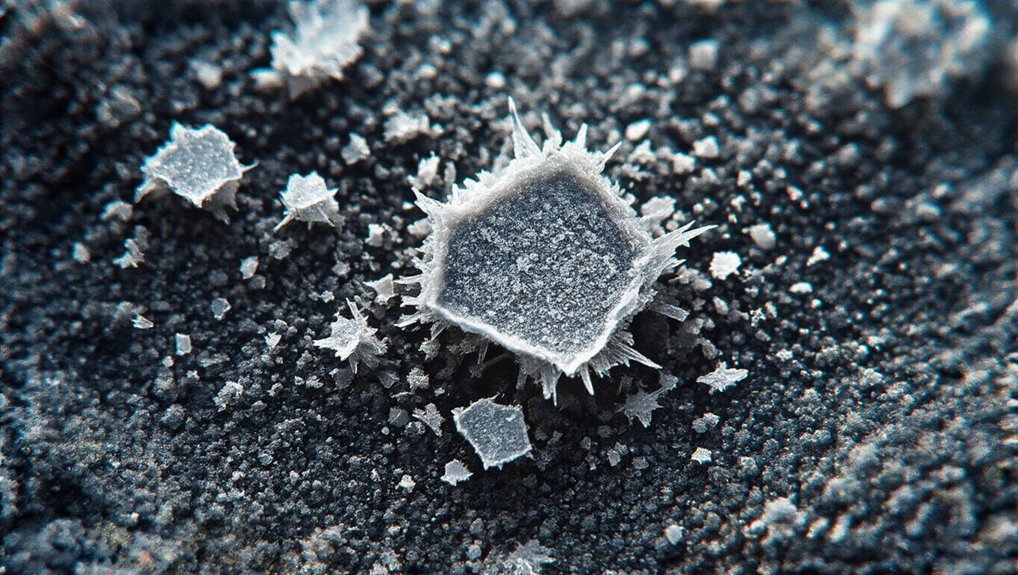

While astronauts have long dreamed of walking on the Moon, few have considered the invisible killer that awaits them there: lunar dust. Not your average household dust, this stuff is mean. Razor-sharp, microscopically fine, and electrostatically charged—it’s basically the glitter from hell, except it can kill you.
Apollo astronauts learned this the hard way. After moonwalks, they returned to their lunar modules sneezing, coughing, with irritated eyes and sore throats. They called it “lunar hay fever.” Cute name for something that could potentially shred your lungs. These symptoms disappeared within 24 hours, sure, but those guys were only up there for a few days. What about the long-haul astronauts NASA’s planning to send?
Apollo astronauts battled “lunar hay fever” for days. Future lunar settlers might face a lifetime of dust-induced misery.
The dust is worse than typical Earth dirt because it’s never been weathered. No wind, no water—just billions of years of meteorite impacts creating tiny, jagged shards that smell like spent gunpowder. Lovely vacation spot, right?
Scientists now know this nasty stuff has chemically reactive surfaces. Translation: it’s toxic. The smallest particles can dive deep into your alveoli—you know, those tiny air sacs where your blood picks up oxygen. Kind of important for, well, staying alive.
Lab tests show the dust damages DNA in lung cells. Let that sink in. DNA damage. As in mutations. As in cancer. NASA has established exposure limits, but come on—how exactly do you control microscopic, statically-charged particles in a lunar habitat?
Extended missions mean extended exposure. What starts as irritation could develop into chronic bronchitis or lung fibrosis. The stuff accumulates in airways. It doesn’t play nice with human tissue.
Everyone’s excited about returning to the Moon. Building bases. Making history. Recent studies by Michaela Smith at the University of Technology Sydney show that moon dust is actually less toxic than urban air pollution. The research employed LMS-1 and LHS-1 lunar dust simulants to assess potential health impacts. Meanwhile, this silent, abrasive menace waits. Apollo astronauts got lucky with their brief visits. Future moonwalkers might not be so fortunate. Something to think about while gazing romantically at that glowing orb in the night sky.
References
- https://www.space.com/astronomy/moon/moon-dust-is-less-toxic-than-urban-air-pollution-scientists-discover
- https://www.discovermagazine.com/the-sciences/breathing-lunar-dust-is-bad-for-our-bodies-but-not-as-bad-as-city-dust-on
- https://www.innovations-report.com/science-tech/physics-and-astronomy/report-109912/
- https://news.stonybrook.edu/newsroom/press-release/general/2018_05_04_lunar_dust/
- https://humanresearchroadmap.nasa.gov/evidence/reports/lunar dust.pdf