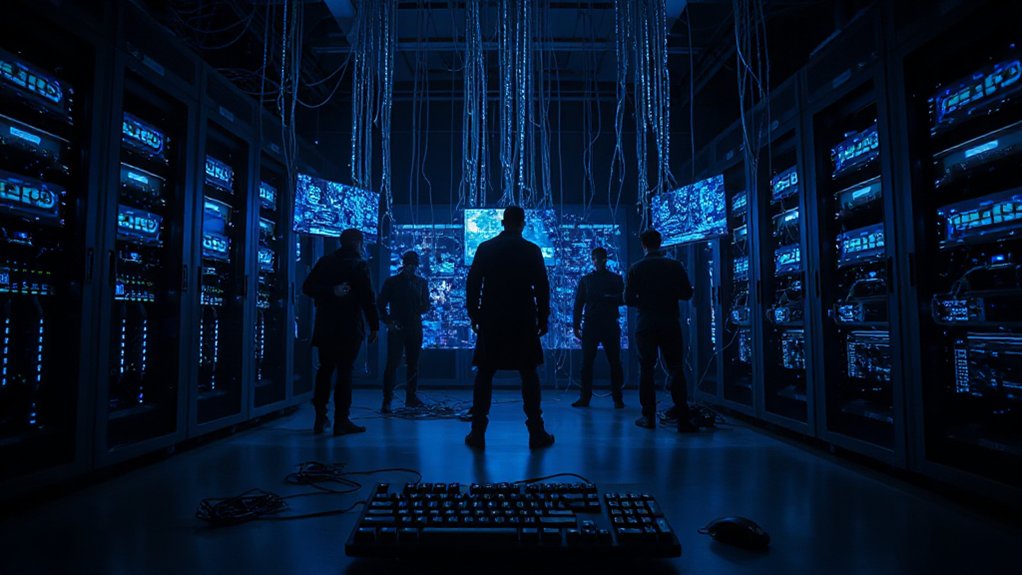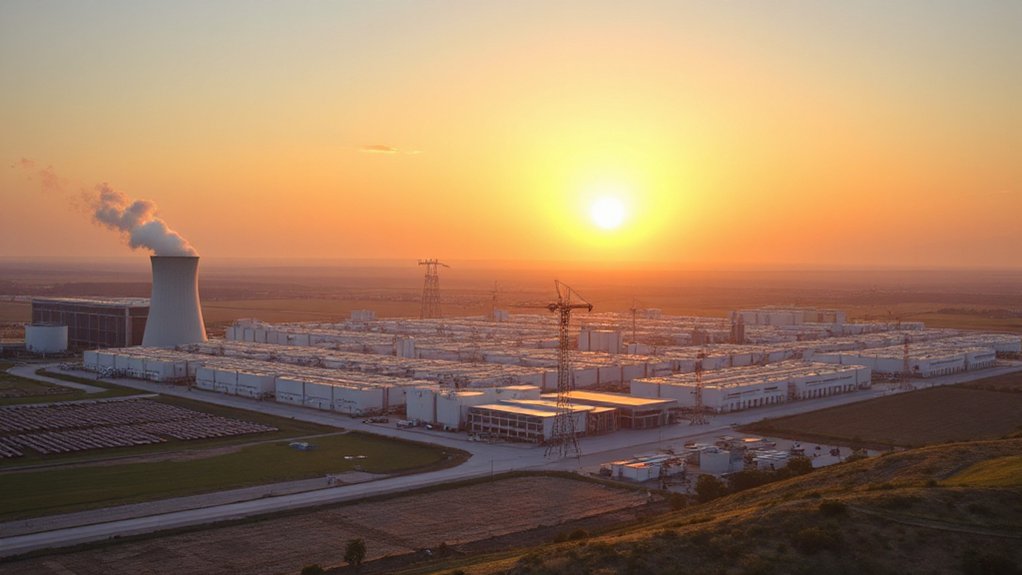

While most people think of artificial intelligence as digital software, it’s creating a massive physical footprint across the global real estate landscape. Global investment in data centers hit $61 billion in 2025, mostly due to growing AI workload demands. This represents part of a larger $4 trillion economic opportunity, where data centers serve as the essential infrastructure.
The biggest tech companies, known as hyperscalers, are spending the most money on new capacity. They’re building massive data centers to keep up with AI needs. The industry is seeing the development of mega-campuses with at least 1 gigawatt of power capacity to support these extensive operations. Current development plans show there’s still not enough space to meet demand. Many markets report high prelease rates, indicating scarcity of available facilities.
AI is changing what kind of real estate developers need. Companies now hunt for large land parcels that can support multi-megawatt campuses. This search is pushing development into new areas and greenfield sites. The global vacancy rate for data centers sits at just 6.6%, showing how quickly new space is being filled.
Power availability has become a major limitation. AI-driven growth is greatly increasing energy demands through 2030. Companies prefer regions with cheaper, abundant power like parts of the U.S. Southwest and Nordic markets. Many operators are investing in renewable energy sources to meet both their green goals and secure long-term energy supplies. Des Moines has emerged as a particularly attractive location due to its abundant wind-powered energy. AI computation is particularly energy-intensive, with experts predicting that data centers could consume 6-12% of electricity in the US by 2028.
Cooling technology is evolving too. AI training requires high-density computing, which generates more heat. This is driving adoption of liquid cooling and other efficient cooling systems. Facilities are being redesigned with larger halls to support multi-megawatt clusters.
Secondary markets like Phoenix, Atlanta, Mumbai, and Bogotá are seeing rapid growth as primary markets face land constraints. Getting into these markets now depends not just on finding land, but also securing utility capacity. The combination of land scarcity, power constraints, and complex permitting is reshaping how and where these essential AI facilities can be built.
References
- https://www.blackrock.com/ca/institutional/en/insights/the-ai-real-estate-opportunity
- https://www.cbre.com/insights/reports/global-data-center-trends-2025
- https://www.bain.com/insights/ai-data-center-forecast-from-scramble-to-strategy-snap-chart/
- https://www.eweek.com/news/data-center-investment-2025/
- https://www.cushmanwakefield.com/en/insights/global-data-center-market-comparison
- https://www.jll.com/en-us/insights/market-outlook/data-center-outlook
- https://www.thebusinessresearchcompany.com/report/ai-in-real-estate-global-market-report