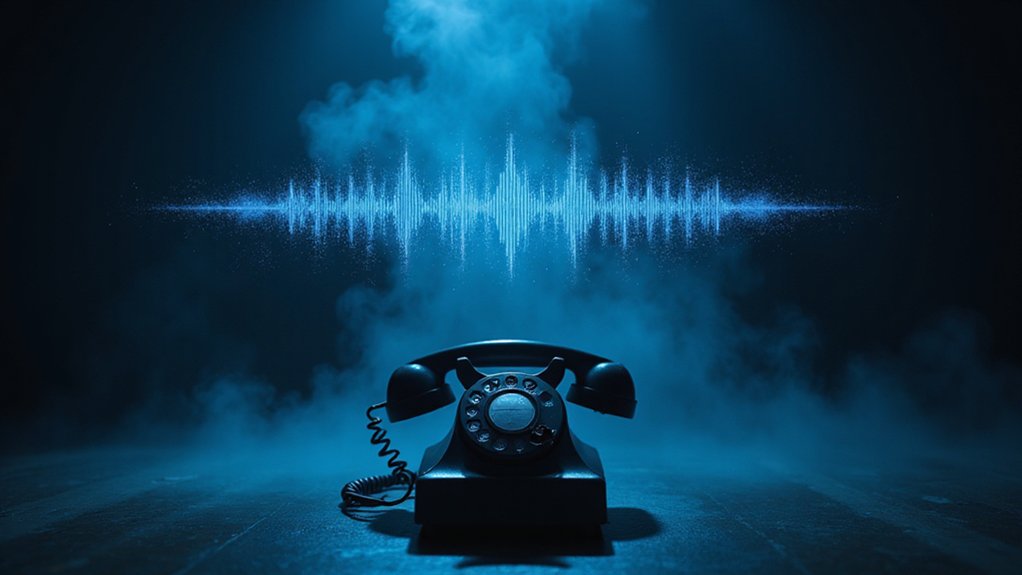
The voice on the phone sounds perfect—too perfect. Every word lands with mechanical precision, each syllable hitting its mark like a trained archer who never misses. That’s when the brain starts screaming: this isn’t human.
AI speech has gotten scary good lately. Neural networks pump out voices that almost nail human conversation. Almost. The technology can clone anyone’s voice with just minutes of recorded speech, which is both impressive and deeply unsettling. These systems use context-aware processing to adjust responses on the fly, predicting what should come next in a conversation.
But here’s the thing: they still screw up in weird ways. The pacing stays too consistent, like a metronome nobody asked for. Real humans speed up, slow down, stumble. AI doesn’t. It maintains this eerie steadiness that makes skin crawl. The prosody—that’s the fancy word for intonation and stress—comes out hyper-precise. No subtle unpredictability. No charming imperfections.
Then there’s the repetition problem. AI loves recycling phrases and sentence structures way more than any normal person would. It struggles with slang and regional accents, turning colloquialisms into awkward approximations. Sarcasm? Forget it. The machine might try, but it lands about as well as a lead balloon.
Brain scans reveal something fascinating: human brains literally process AI speech differently. Different neural regions light up. The mind knows something’s off, even when the ears can’t quite pinpoint what. This creates what researchers call a “digital accent”—those subtle tells that scream artificial origin.
Some people report feeling haunted during extended AI conversations. The uncanny valley effect kicks in hard. Others notice their own speech patterns changing after frequent AI interactions, which is its own special kind of creepy. Companies like Potential.com have developed AI agents specifically designed to enhance business communication, yet even these sophisticated tools can’t fully escape the digital accent problem. In healthcare settings, where the AI market is projected to grow to $187 billion by 2030, these speech pattern issues could impact patient trust and engagement.
The most damning evidence? AI defaults to neutral accents and overly formal language. It might nail emotional depth in controlled scenarios, but throw in some ambiguity or humor, and the facade cracks. Those rare mispronunciations on uncommon names become digital fingerprints. Speech recognition systems struggle with homophones that sound identical but have different meanings, adding another layer to their artificial tells.
Listeners unconsciously adjust their expectations when detecting AI. Emotional engagement drops. The conversation feels hollow, despite the technical sophistication. That digital accent haunts every exchange, a ghostly reminder that perfection itself is the flaw.
References
- https://www.potential.com/articles/what-makes-a-great-ai-voice-agent-7-features-to-look-for-in-2025/
- https://research.aimultiple.com/speech-recognition/
- https://www.afhu.org/2025/03/07/how-the-brain-seamlessly-transforms-speech-patterns-and-words-into-conversations/
- https://www.tavus.io/post/automatic-speech-recognition
- https://storyshort.ai/en/blog/top-ai-voice-trends-for-2025