How exactly does the brain see what it sees? Scientists are now using AI to peek inside our heads and recreate what we’re looking at. Turns out, the brain’s been playing tricks on us all along.
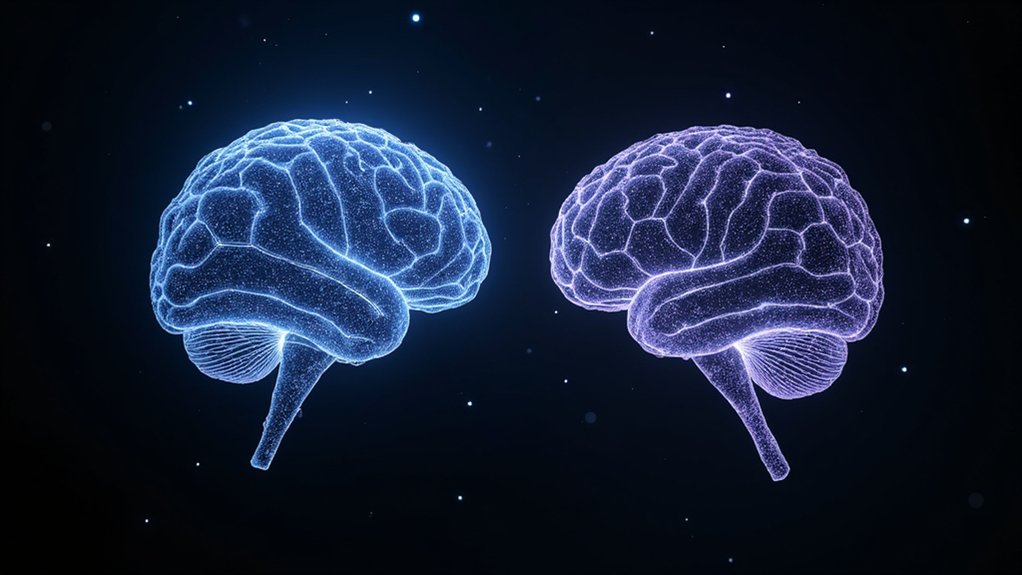
Your occipital lobe handles the boring stuff—layout, perspective, where things are. Meanwhile, the temporal lobes get the fun job of figuring out what you’re actually seeing. People, objects, that weird thing in the corner of your room. Different brain regions literally form pinwheel patterns when processing visual angles. The brain even creates special neighborhoods for faces versus places, like some exclusive neural country club.
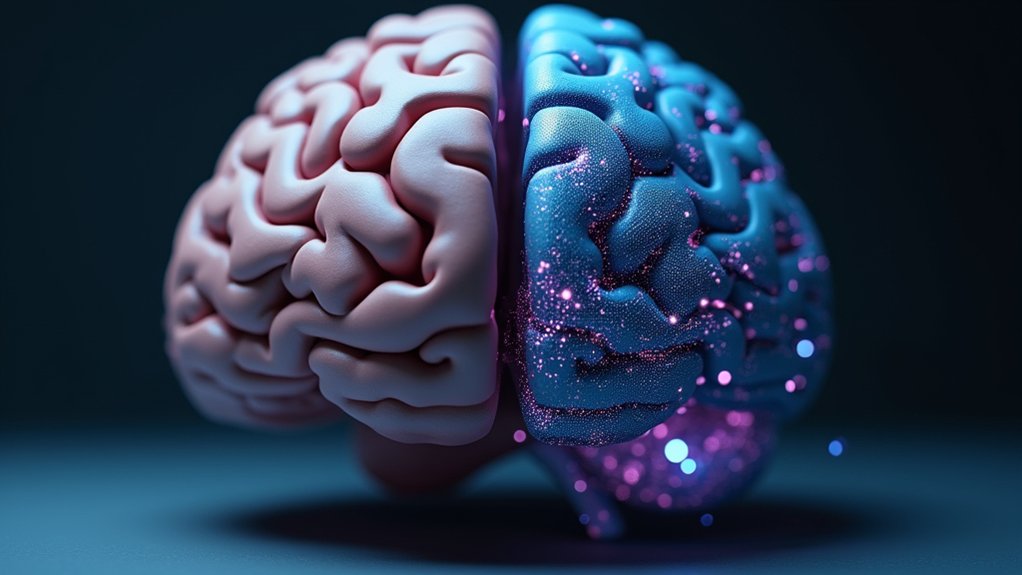
Here’s where it gets wild. Researchers trained AI algorithms on thousands of brain scans from people staring at photos. Feed the AI some fMRI data, and boom—it spits out images matching what participants saw. The Stable Diffusion algorithm starts with visual noise, then gradually forms recognizable images by comparing brain activity patterns. It’s basically mind reading, except real and slightly terrifying.
Stanford scientists cracked open another disturbing truth about how we see faces. Remember thinking you’re not racist? Your brain begs to differ. The Other-Race Effect means people recognize faces from their own race way better than others. University of Toronto researchers hooked people up to EEG machines and watched their brains literally distort facial features of other races. The visual processing happens so deep in the brain, you don’t even know it’s happening.
These AI systems need surprisingly small datasets now. Gone are the days of massive computing requirements. Scientists can train algorithms on individual brain responses and reconstruct what someone’s seeing with creepy accuracy. The technology might even capture imagined thoughts and dreams once researchers refine the system further. Game-based cognitive therapy powered by AI might even reprogram these biased brain responses someday.
The brain organizes sensory information in systematic maps, with neighboring neural groups responding to related stimuli. AI algorithms can now replicate these organizational patterns and convert brain activity back into imitation images. Stanford’s new topographic neural network mimics how nearby neurons share similar responses to visual input, essentially reverse-engineering the brain’s filing system. Different racial groups show completely distinct facial recognition patterns, proving our brains are wired with built-in biases we never consciously chose.
References
- https://www.science.org/content/article/ai-re-creates-what-people-see-reading-their-brain-scans
- https://pubmed.ncbi.nlm.nih.gov/37282741/
- https://neuroscience.stanford.edu/news/neuroscientists-use-ai-simulate-how-brain-makes-sense-visual-world
- https://www.psypost.org/cognitive-psychologist-explains-why-ai-images-fool-so-many-people/
- https://medicalxpress.com/news/2025-05-ai-brain-reveal-racial-groups.html