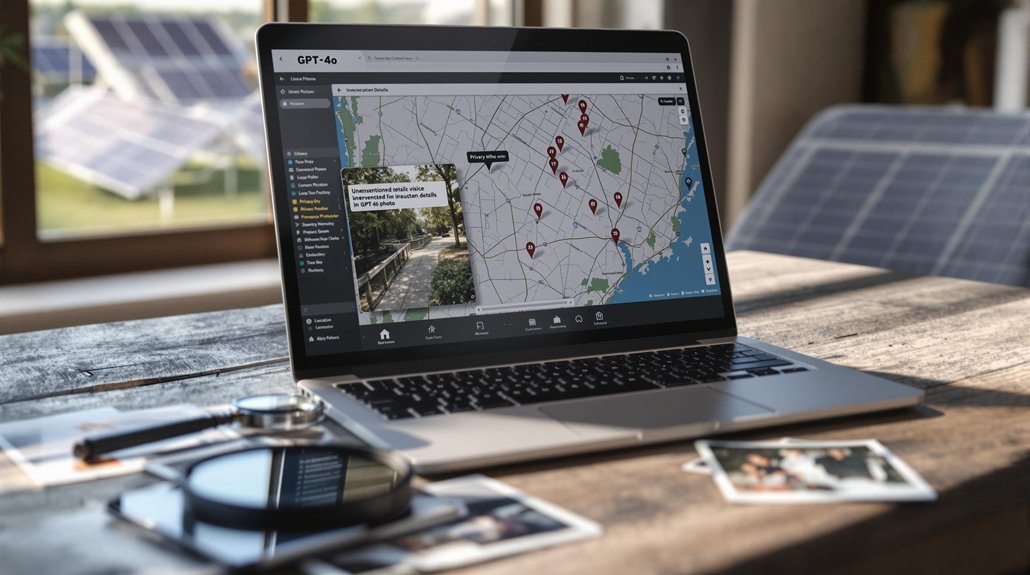

Recent advancements in OpenAI’s GPT-4o have sparked widespread privacy concerns among experts. The AI’s ability to analyze images, extract location data, and perform reverse location searches has raised red flags about potential misuse. Users often share photos without realizing how much personal information they’re exposing. Privacy advocates warn that these tools could enable doxxing or stalking by making it easier to identify where someone lives or works. The question remains: can innovation coexist with personal security?
While OpenAI’s latest model GPT-4o offers impressive new image analysis capabilities, it’s raising serious privacy concerns among experts and regulators. The model can analyze photos with remarkable detail, potentially extracting location information even when that data isn’t obvious to human viewers.
Privacy advocates worry these tools could be misused for doxxing or stalking. Recent viral demonstrations showed how GPT-4o can identify locations from seemingly innocent photos, a capability that caught many users by surprise. This reverse location search feature wasn’t clearly documented in OpenAI’s safety guidelines. The newer o3 and o4-mini models demonstrate even more precise capabilities for identifying locations from visual clues in photographs.
Hidden patterns in casual photos can expose locations, raising serious concerns about potential stalking or doxxing risks.
OpenAI collects a wide range of user content, including images and voice data. User inputs may be stored and used for future training unless specifically opted out. This data collection approach follows a pattern of “collect everything now and sort it out later,” according to the company’s privacy policies. This raises human autonomy concerns as users may not fully understand how their data influences AI decisions without transparent disclosures.
The company’s history with data privacy isn’t spotless. Italian regulators temporarily banned ChatGPT after discovering personal information in training datasets. Previous security issues also revealed chat data stored in plain text on devices.
GPT-4o does include some safety measures. The system implements C2PA metadata to tag AI-generated images and blocks content that violates policies. Images of real people face tighter restrictions, especially regarding nudity and violence.
However, experts question whether these protections are enough. The ability to extract hidden information from photos raises concerns about user anonymity. Many users report that GPT-4o paradoxically claims it cannot analyze images even when prompted to do so. OpenAI describes safety as an ongoing process rather than a completed system.
The company’s compliance with international data protection laws like GDPR remains under scrutiny. As these powerful AI tools become more accessible, calls grow for clearer legal frameworks and ethical standards.
For users sharing images with GPT-4o, the message is clear: the technology can potentially see and understand more than what meets the human eye, with important implications for personal privacy.