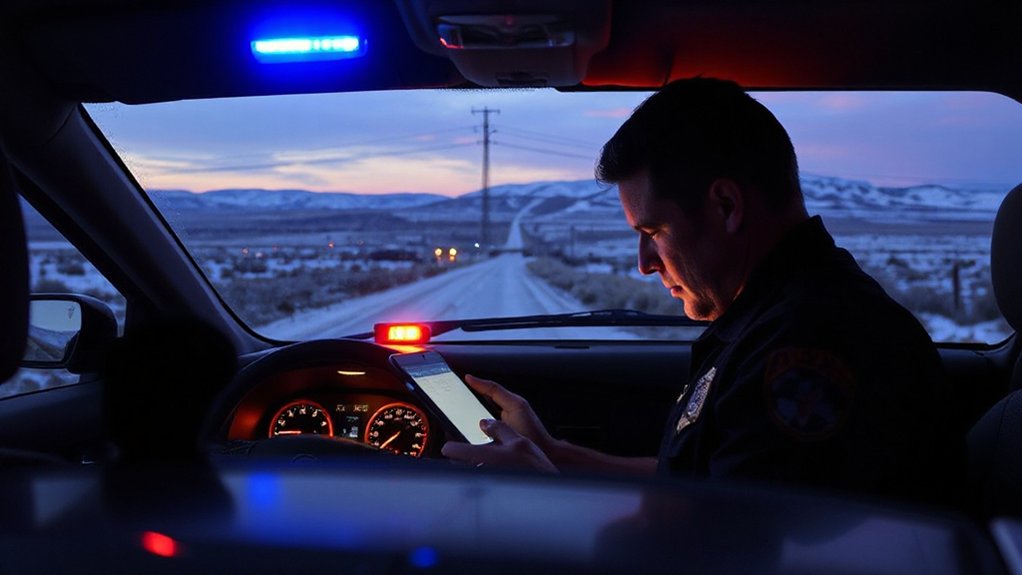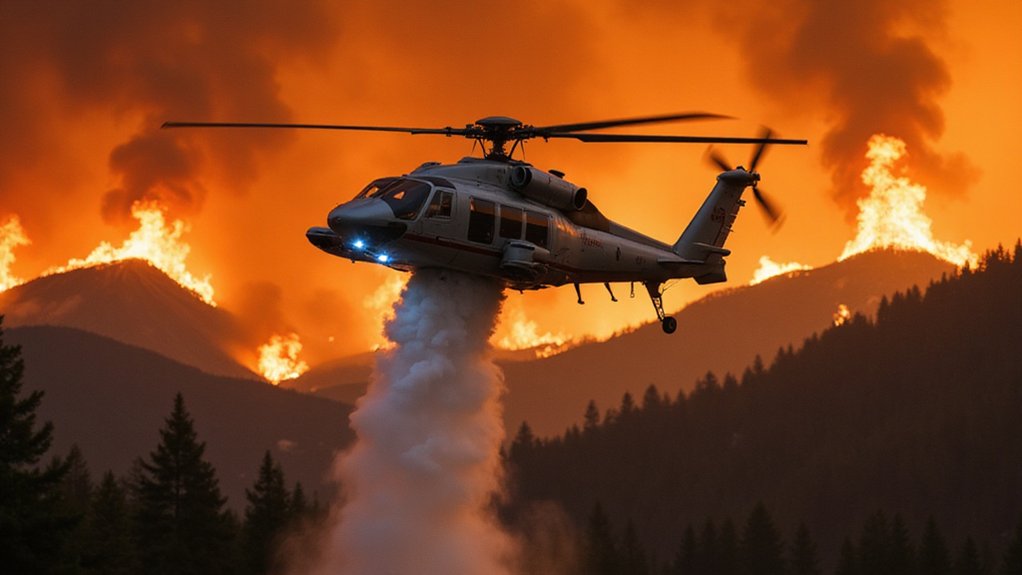

Autonomous helicopters are now fighting wildfires without human pilots. The Firehawk system, recently tested in California, uses thermal sensors and high-resolution cameras to locate fires and drop water precisely. These robot helicopters react faster than human-operated aircraft and can safely operate in dangerous conditions. They’re supported by a network of over 1,100 fire watch cameras across the American West. This technology could transform how we respond to increasingly threatening wildfires.
Soaring through smoke-filled skies, autonomous helicopters are transforming how wildfires are fought across America. The Firehawk helicopter system can take off, collect water, and extinguish fires without any human pilot on board. These flying robots operate through mission commands entered by operators rather than direct piloting.
The aircraft are equipped with thermal sensors that independently scan for fire locations. Computer algorithms determine the best way to attack the flames, choosing between line drops or spot drops based on what they see. These smart systems even account for wind conditions to guarantee water hits its target accurately.
Rain and Sikorsky recently demonstrated end-to-end autonomous wildfire response. Their technology handles everything from early detection to dispatch, route planning, takeoff, and landing. The aircraft can operate water buckets on their own and use high-resolution cameras to find and target fires precisely. Recent test runs in Hesperia, California showed promising results for the system’s real-world application.
This technology combines several advanced components. The system uses AI-powered FireScout cameras for early detection and Sikorsky’s MATRIX flight system to control the aircraft. Rain’s mission system processes images from onboard cameras to direct both flight paths and water release timing.
The autonomous system offers clear advantages over human pilots. It reacts faster, makes more accurate water drops, and can safely operate in challenging conditions. It also reduces the risk of mid-air collisions, which have caused tragic accidents in the past. These innovations could help compensate for the staffing reductions that have left many forests dangerously undermanaged.
A network of over 1,100 fire watch cameras across California and the American West supports these efforts. When fires are detected, Rain’s system analyzes their characteristics and designs appropriate suppression strategies automatically.
The future vision includes positioning fleets of these robot helicopters strategically to fight fires in their earliest stages. This approach could prevent small fires from growing into major disasters.
Another innovation, the Dragon Firefighter robot, offers a different design that keeps first responders safe by enabling firefighting from a distance. With its ability to fly and deploy eight controllable jets, the Dragon Firefighter represents another promising advancement in robotic firefighting technology.
References
- https://abc7.com/post/autonomous-firefighting-firehawk-helicopter-designed-put-fires-may-solution-increased-efficiency-safety/16297253/
- https://dronelife.com/2023/12/27/dragon-firefighter-robot-fights-fires-from-a-distance/
- https://news.lockheedmartin.com/2024-11-11-Sikorsky-and-Rain-Successfully-Demonstrate-Autonomous-Flight-with-Wildfire-Mission-Autonomy-to-Rapidly-Find-and-Suppress-Test-Fires
- https://www.therobotreport.com/watch-an-autonomous-helicopter-demo-wildfire-response-skills/
- https://www.rain.aero