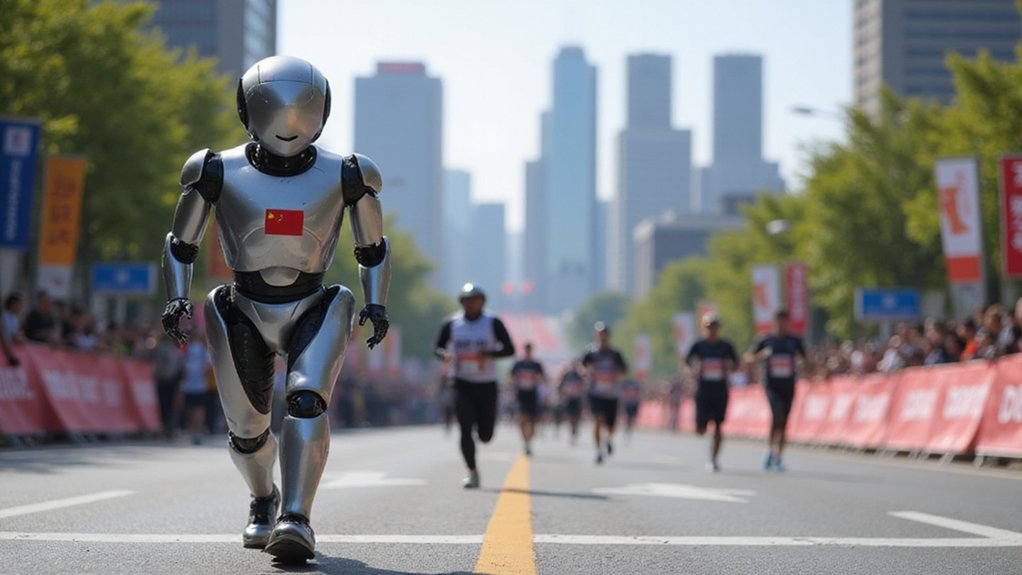

China’s latest humanoid robot is turning heads. Kinetix AI, based in Shenzhen, has disclosed a humanoid robot called KAI. It stands 173 centimeters tall and weighs 70 kilograms. That’s about five feet eight inches and 154 pounds. The robot’s design is faceless and built for homes and service jobs.
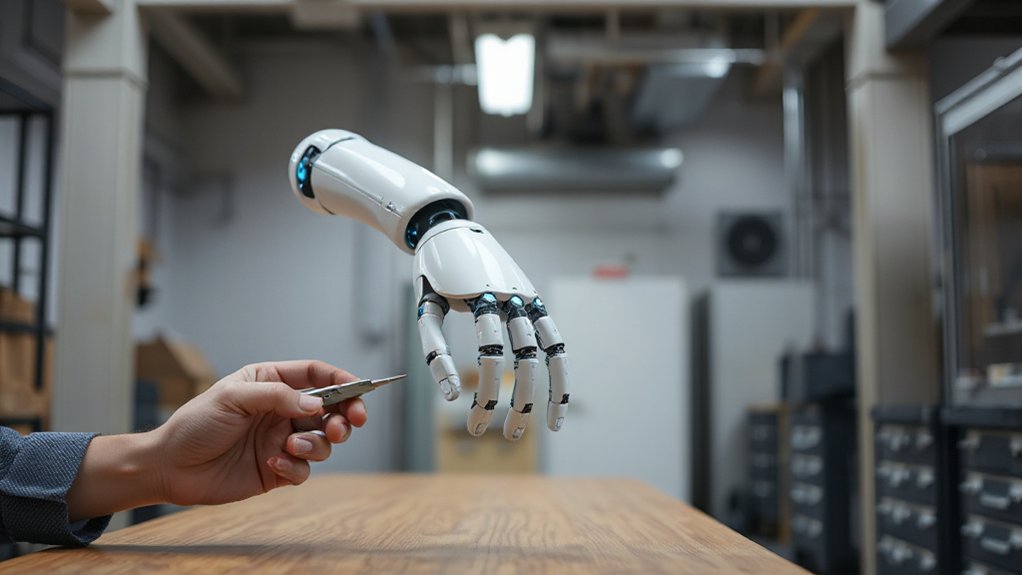
KAI’s body has 115 degrees of freedom. That’s a technical way of saying how many ways it can move. Most humanoid robots can’t match that number. Each hand alone has 36 degrees of freedom. That gives KAI 72 across both hands combined. The hands include 22 active joints for precise control and 14 passive joints. Those passive joints act as shock absorbers, helping the robot handle impacts without needing a computer to react.
KAI’s 115 degrees of freedom set it apart — most humanoid robots simply can’t move like this.
The robot’s skin contains 18,000 sensing points across its body. These sensors can detect forces as low as 0.1 newtons. That’s an incredibly light touch. This system lets KAI adjust its grip in real time. It can handle fragile objects without breaking them. It’s also designed to interact with people safely.
KAI runs on a 1.7-kilowatt-hour semi-solid-state battery. This type of battery lowers the risk of overheating and fires. The robot connects via Ethernet or Wi-Fi. It also uses large language models for smarter processing. Kinetix AI says KAI’s vision system mimics how humans see the world. To support its training, Kinetix AI developed a wearable device called KAI Halo that captures first-person video and spatial data to build diverse datasets.
Kinetix AI’s plans target mass production by late 2026. The company wants KAI working in homes, service industries, and complex operations. China’s broader robotics push backs this effort. State Grid, a Chinese energy company, plans to deploy 500 humanoids for power line maintenance. It’s also adding 5,000 robot dogs and 3,000 dual-arm robots.
KAI isn’t the only humanoid making news. The Unitree G1, another Chinese robot, costs between $13,500 and $18,000. It has far fewer joints but includes a depth camera and 3D LiDAR. China’s overall robotics sector investment is forecasted to exceed 10 billion yuan in 2026, signaling strong financial backing for companies like Kinetix AI. Some observers have questioned whether KAI’s marketing videos showcase a real robot or high-end computer graphics. That question hasn’t been fully answered yet.
References
- https://interestingengineering.com/ai-robotics/china-8500-robots-power-grid
- https://interestingengineering.com/ai-robotics/chinas-humanoid-robot-with-115-degrees-of-freedom
- https://www.youtube.com/watch?v=NwhjrQYAYEg
- https://news.robot.tv/chinas-life-size-humanoid-robot-with-18000-sensors-masters-115-degrees-of-freedom/
- https://www.youtube.com/watch?v=kgUKHdYvF6M&vl=en
- https://www.unitree.com/g1