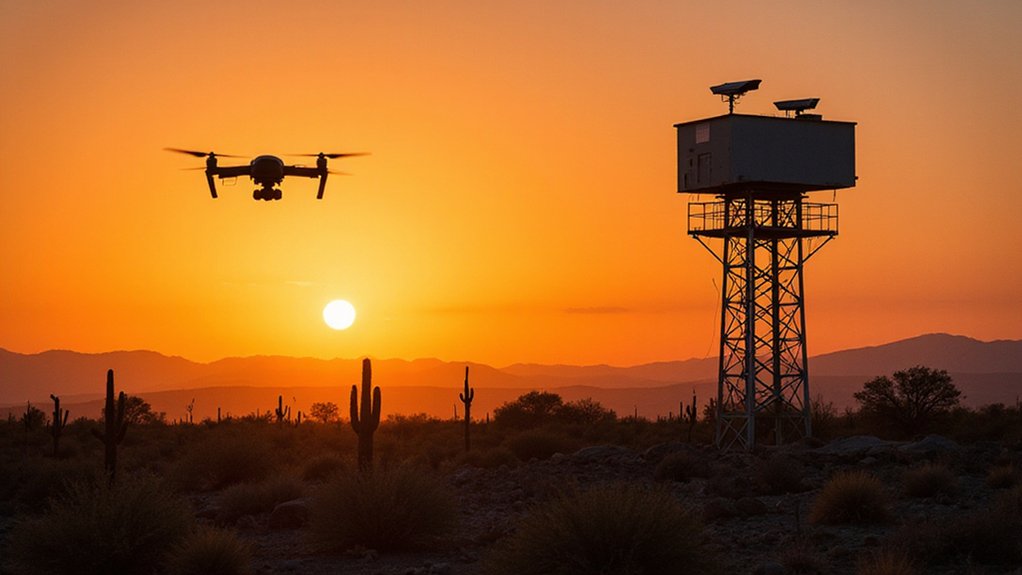

While politicians bicker about walls and funding, the real transformation at the U.S.-Mexico border is happening through silicon chips and algorithms. The Pentagon’s counter-drone systems, set to deploy by mid-2025, aren’t just fancy toys. They’re designed to neutralize cartel drones that have been buzzing around U.S. troops like annoying mosquitoes with cameras. These cartel drones have been conducting unauthorized surveillance to assess troop sizes and movements, even enabling kinetic attacks against U.S. forces.
Customs and Border Protection already runs AI-operated cameras along the border as of May 2025. These aren’t your grandfather’s security cameras. They’re smart, they’re always watching, and they’re getting better at predicting what happens next. Aerial surveillance vehicles cruise the skies, while satellites beam down images that algorithms chew through faster than any human analyst could dream of. The technology is proving its worth with apprehensions plummeting from 249,741 in December 2023 to just 7,181 in March 2025, a staggering 95% decrease.
The cartels? They’re not exactly thrilled. That major cartel bust in July 2024 happened partly because AI systems connected dots humans missed, sifting through mountains of social media posts, financial records, and other digital breadcrumbs. It’s like having a thousand detectives who never sleep, never get tired, and definitely never take bribes.
Congress actually agreed on something for once. The Emerging Innovative Border Technologies Act passed the House in March 2025, though the Senate’s still dragging its feet. Shocking, right? Meanwhile, DHS released its AI roadmap in 2024, promising to balance security with civil liberties. We’ll see how that goes.
The real game-changer might be the smuggling detection systems. AI tools triage massive amounts of open-source information, helping agents intercept record amounts of fentanyl. These algorithms spot patterns in trafficking activities that human analysts might miss after staring at spreadsheets for twelve hours straight. The integration of machine learning has significantly improved pattern recognition capabilities, identifying health and security risks that traditional analysis would overlook.
Migration prediction is where things get interesting. AI systems analyze social media from Honduras and El Salvador, tracking recruitment by smuggling networks and anticipating migration waves before they hit the border. It’s predictive policing on steroids, minus the RoboCop.
Identity verification at border crossings now involves AI-powered biometric systems that can spot fake documents faster than you can say “visa fraud.” The machines don’t care about sob stories or bribes. They just scan, analyze, and decide.
Welcome to the future of border security, where the real barrier isn’t made of steel or concrete—it’s made of code.
References
- https://defensescoop.com/2025/04/29/dod-counter-small-drones-u-s-mexico-border-cartels-surveil-troops/
- https://www.aa.com.tr/en/americas/us-mexico-border-enters-counterterrorism-era-amid-crackdown-on-drug-cartels/3573373
- https://3gimbals.com/insights/osint-and-ai-in-u-s-law-enforcement-evolving-tools-from-border-security-to-federal-courts/
- https://fedscoop.com/ai-border-technology-dhs-enforcement-bill/
- https://www.nextgov.com/artificial-intelligence/2024/07/ai-can-enhance-border-security-wont-close-workforce-gap-lawmakers-say/397943/