
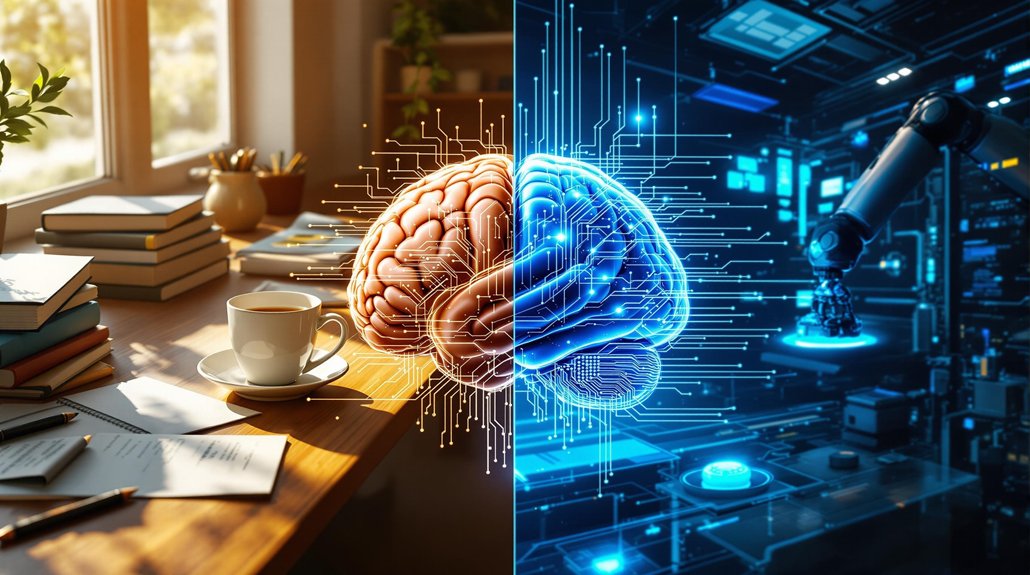
AI systems sometimes fabricate facts due to flaws in their neural circuits. These circuits, inspired by the human brain, can suffer from “catastrophic forgetting” where new information replaces old knowledge. Recent research like the CH-HNN model aims to address these issues by mimicking brain mechanisms. Scientists are exploring new perspectives on neuron function and circuit motifs to understand why AI hallucinates information. Ethical audits of these systems could help close this truth gap.
The transformation in artificial intelligence is taking a biological turn. Scientists now look to the human brain for clues to improve AI systems. They’re creating models inspired by how our brains process information. These brain-inspired approaches help solve major problems in current AI.
One key challenge for AI is “catastrophic forgetting.” This happens when new information overwrites old knowledge. The Corticohippocampal Hybrid Neural Network (CH-HNN) tackles this problem. It mimics the recurrent loop cycle in human brains. This lets AI systems learn continuously without losing previous knowledge. Traditional systems suffer from catastrophic forgetting limitations that prevent them from effectively incorporating new data while maintaining past information.
AI systems struggle with forgetting old knowledge when learning new information—a challenge brain-inspired models are now solving.
Neural circuit modeling combines artificial neural networks (ANNs) with spiking neural networks (SNNs). This mix creates systems that can both store specific memories and make generalizations. It’s similar to how our brains balance detailed and abstract thinking.
Researchers have found that evolved neural circuits perform well on complex tasks. These systems do better on image classification and show more resistance to attacks. They’re also less affected by noise in the data, making them more reliable.
A new “neuron-as-controller” model challenges ideas from the 1960s. It suggests neurons actively control their environment rather than just processing inputs. This shift in thinking could lead to more powerful AI systems.
Scientists are also studying how AI networks organize information. Some models use “unioning over cases” to recognize objects from different angles. Others employ “superposition,” where neurons handle multiple features at once. These discoveries show that AI systems develop sophisticated strategies for processing information.
Circuit motifs act as building blocks in neural networks. They include patterns like feed-forward excitation and lateral inhibition. Understanding these structures helps researchers peek inside the “black box” of AI systems. Current AI systems often rely on a single architecture, limiting their potential compared to the diverse architectural combinations found in the brain. Regular ethical audits of neural circuits are necessary to ensure AI systems remain fair and transparent in their decision-making processes.