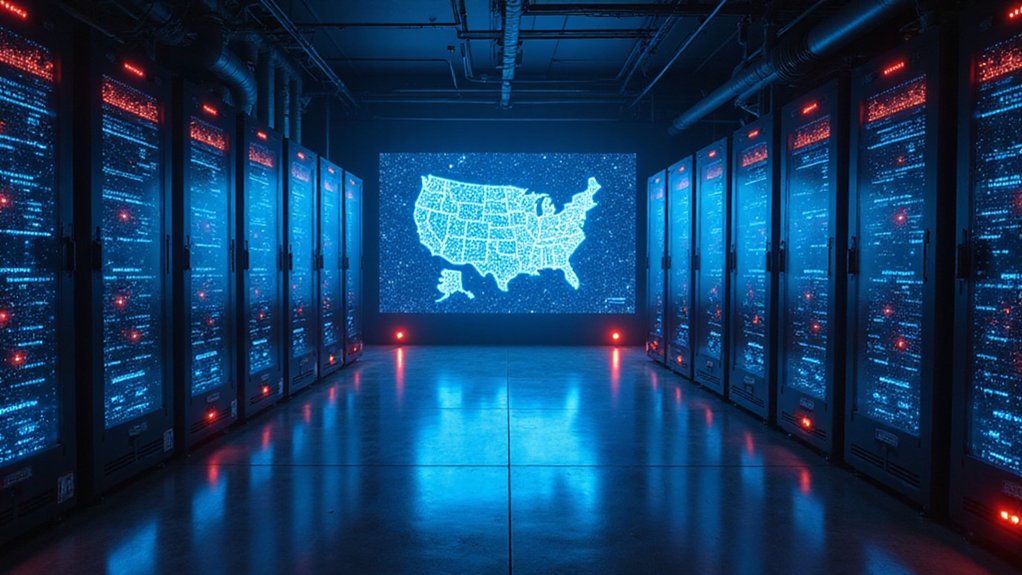

Most Americans have no clue their government runs a massive AI operation from a central command center. The National Artificial Intelligence Initiative Office has been quietly coordinating federal AI activities since January 2021, operating as the brain trust for government-wide artificial intelligence deployment.
This isn’t some conspiracy theory. Congress literally passed the National Artificial Intelligence Initiative Act of 2020, creating this centralized hub. The office functions as the primary contact point between federal agencies, private companies, and international partners. They even maintain AI.gov as their public face, though few citizens bother to check it out.
Congress created a centralized AI hub that coordinates between federal agencies, private companies, and international partners.
The office’s mandate reads like something from a tech thriller. They oversee implementation of the national AI strategy, guarantee coordination between agencies, and facilitate AI system deployment across the entire federal government. Every three years, they update the National AI R&D Strategic Plan based on input from government, industry, and academia. The White House OSTP emphasizes the critical importance of AI integration in federal operations.
Federal agencies are already knee-deep in AI deployment. They’re using it to automate administrative tasks, enhance data analysis, and run predictive analytics for everything from cybersecurity to resource allocation. The technology streamlines processing workloads and reduces administrative overhead. Basically, machines are doing jobs that used to require human federal workers.
What’s particularly striking is the scope of investment. The government committed to doubling AI research funding and establishing dedicated research institutes. They’re pouring money into fundamental AI research and technological innovation, with sustained R&D investment aimed at rapid change from laboratory breakthroughs to real-world deployment. These institutes focus on synthetic manufacturing, precision agriculture, and extreme weather prediction.
The legislative framework guarantees this isn’t going away. The 2020 Act codifies governance and federal coordination of AI activities, mandates regular reviews, and ensures sustained funding. Federal leadership openly acknowledges AI as critical to national security and economic competitiveness.
International partnerships are part of the package too. The U.S. released its first AI regulatory guidance and formed global alliances to guide “responsible” AI development. They’re pushing for international regulatory alignment while maintaining American leadership in the field. AI security measures are becoming essential as these systems can analyze unusual patterns that might indicate cyberattacks against critical infrastructure.
The infrastructure for nationwide AI deployment already exists. It’s funded, operational, and expanding.
References
- https://www.nextgov.com/artificial-intelligence/2021/01/white-house-launches-central-hub-artificial-intelligence-research-and-policymaking/171346/
- https://trumpwhitehouse.archives.gov/briefings-statements/white-house-launches-national-artificial-intelligence-initiative-office/
- https://blog.shi.com/business-of-it/artificial-intelligence/how-federal-agencies-use-ai/
- https://www.policingproject.org/ai-policy-hub
- https://www.uspto.gov/sites/default/files/documents/National-Artificial-Intelligence-Initiative-Overview.pdf