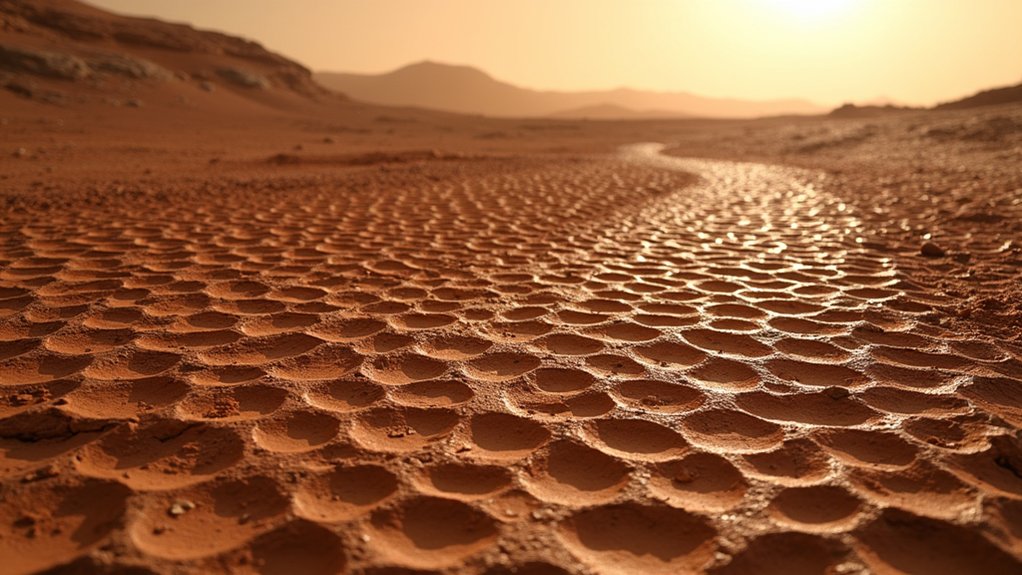

The waffle iron left its mark on Mars. Those bizarre honeycomb ridges stretching across the Red Planet’s terrain aren’t breakfast leftovers—they’re ancient water‘s calling card. NASA’s Curiosity rover keeps stumbling upon these peculiar patterns, each one about a centimeter high, forming networks that would make any bee jealous.
Scientists love a good mystery, and Mars delivered. These polygonal cracks span massive distances, some reaching 30 meters long. The western floor of Hellas basin alone sports a honeycomb strip measuring 490 kilometers by 60 kilometers. That’s a lot of waffles. Researchers have cataloged 952 locations featuring these ridges, covering roughly one-fifth of the planet’s terrain. Not bad for a supposedly dead world. The southern hemisphere shows particularly high concentrations of these features due to its ancient, crater-rich surface.
The formation story reads like geological poetry. Water froze, thawed, froze again. Cracks formed. Erosion-resistant materials filled them. Then the softer ground around them eroded away, leaving these raised ridges standing proud like nature’s own topographical map. It’s basically Mars playing the long game—millions of years of patience resulting in patterns that would make any landscape architect weep. The honeycomb cells themselves reach impressive depths, plunging up to 170 meters deep into the Martian surface.
Mars playing the long game—millions of years of patience resulting in patterns that would make any landscape architect weep.
Curiosity’s instruments, including APXS and ChemCam, have been busy analyzing these formations. The chemical verdict? Clay minerals. Translation: water was definitely involved. These ridges aren’t just pretty patterns; they’re time capsules preserving evidence of Mars’ wetter past. Some formed through river action, others through wind erosion, but water remains the star player in this geological drama.
Earth has similar features in permafrost regions, where freeze-thaw cycles create comparable polygonal patterns. It’s oddly comforting knowing Mars and Earth share this geological quirk. These Martian honeycombs tell a climate story spanning millions of years—wet periods, dry spells, temperature swings that would make any weather forecaster quit.
The implications hit hard. These ridges suggest Mars once hosted conditions potentially suitable for life. Not little green men, but maybe something microscopic. Each polygon represents a chapter in Mars’ biography, written in stone and preserved for rovers to read. The planet’s ancient floodplains, crater interiors, and wind-sculpted regions all bear these marks, silent witnesses to a time when water ruled the Red Planet.
References
- https://science.nasa.gov/blog/sols-4529-4531-honeycombs-and-waffles-on-mars/
- https://agupubs.onlinelibrary.wiley.com/doi/full/10.1002/2016JE005007
- https://marspedia.org/Geological_processes_that_have_shaped_Mars:_Why_Mars_looks_like_it_does
- https://universemagazine.com/en/martian-waffles-curiosity-detects-mysterious-cracks-in-the-planets-surface/
- https://earthsky.org/space/life-supporting-rivers-for-mars-curiosity-rover-bench-and-nose/