Remorse, it seems, has a price tag. Einstein’s letter expressing profound regret over his role in the atomic bomb‘s creation is heading to auction with an estimated value between $100,000 and $150,000. The timing? Impeccably awful, as usual.
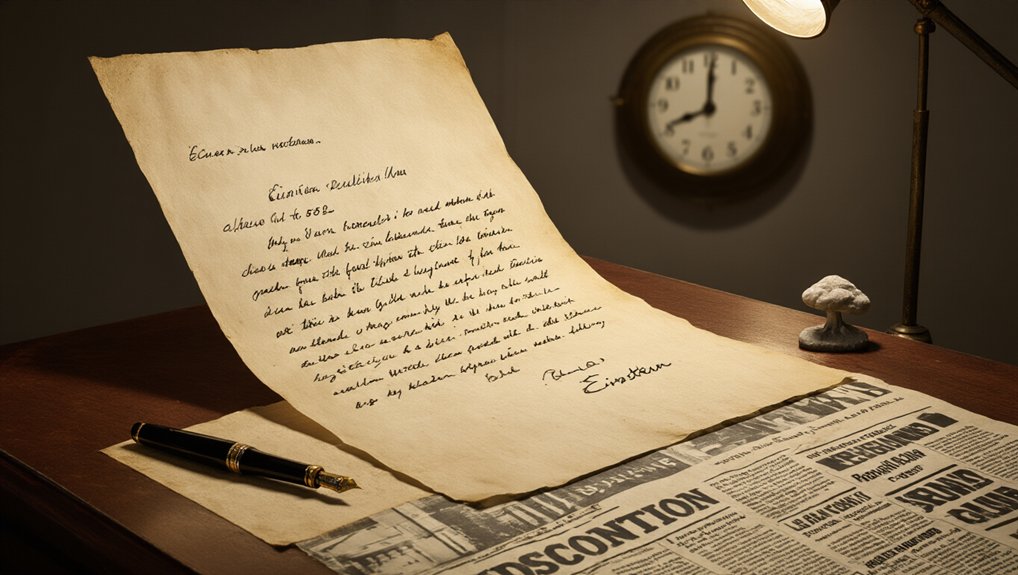
The 1953 letter, published in Japan’s *Kaizō* magazine, represents one of Einstein’s rare public statements lamenting the catastrophic potential of nuclear weapons. Funny how hindsight works when you’ve helped release humanity’s most destructive force. The letter failed to sell when auctioned in June 2025, proving that even genius-level guilt sometimes lacks market appeal.
Einstein’s remorse came too late—as if nuclear devastation could be erased with well-crafted regrets from a safe distance.
Meanwhile, Einstein’s more famous letter—the 1939 warning to President Roosevelt that kick-started the Manhattan Project—fetched a staggering $3.9 million at auction in 2024. That’s right, the letter that Einstein later considered his biggest regret is now worth millions. Irony’s expensive these days.
Christie’s NYC is raising the stakes even higher, offering an unsent, signed version of the Roosevelt letter from the Paul G. Allen Collection. Estimated value? A cool $4-6 million. Nuclear anxiety apparently appreciates better than real estate.
The 1939 letter, co-authored with physicist Leo Szilard, warned of Nazi Germany’s atomic ambitions and urged immediate U.S. action. Einstein never directly worked on developing the bomb, but his equations made it possible. Talk about unintended consequences. He had repeatedly described himself as a committed pacifist who fundamentally opposed war in all forms.
These documents have become cornerstone primary sources in studying nuclear history and Cold War politics. Historians and collectors alike view them as pivotal texts in the moral debate over scientific responsibility during wartime. Einstein himself closed the letter with admiration for Gandhi and his philosophy of peaceful resistance.
The original Roosevelt letter—the one that actually changed history—remains safely housed at the Franklin D. Roosevelt Library in Hyde Park, NY. No auction paddle needed to view that piece of world-altering correspondence.
As bidding begins amid renewed global tensions, Einstein’s words echo with uncomfortable relevance. Some things never change: regrets come too late, and humanity’s deadliest mistakes always find enthusiastic buyers.
References
- https://www.popsci.com/science/einstein-letter-to-japan-auction/
- https://www.iflscience.com/on-my-participation-in-the-atomic-bomb-project-einsteins-powerful-letter-goes-up-for-auction-for-150000-79723
- https://www.christies.com/en/lot/lot-3886884
- https://www.aol.com/einsteins-1939-letter-warning-atomic-223929104.html
- https://www.finebooksmagazine.com/fine-books-news/einsteins-nuclear-warning-letter-president-roosevelt-auction-4m-6m-estimate