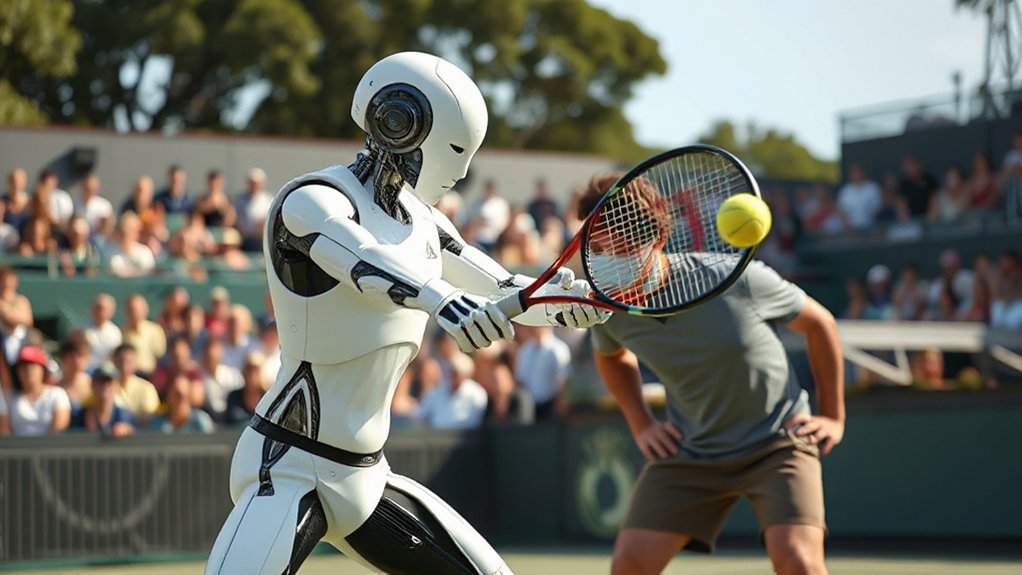

Uncertainty looms over the artificial intelligence landscape as 2025 approaches. Experts predict major changes that will affect businesses and everyday life. Companies rushing for quick AI profits face challenges as real returns take longer than expected. New rules like the EU AI Act will force businesses to be more open about how their AI systems work.
AI’s future brings both promise and uncertainty, demanding patience as regulations tighten and quick profits prove elusive.
Most companies trying to build advanced AI agents on their own aren’t succeeding. Only 23% of organizations have scaled AI agents in at least one business area. The successful ones work with outside experts instead of going it alone. They combine multiple AI models that can handle different tasks working together.
Top-performing companies redesign their workflows around AI instead of just adding it to existing processes. These companies see profits increase by 5% or more. They treat AI as a way to transform how work gets done rather than just a tool for small improvements. Survey data indicates that nearly two-thirds of organizations are satisfied with AI investments showing less than 50% ROI, demonstrating realistic expectations for this emerging technology. The current excitement surrounding AI capabilities represents frantic hype that doesn’t always align with practical implementation realities.
Economic predictions for AI vary widely. McKinsey suggests AI could add up to $25.6 trillion to the global economy each year. But MIT economist Daron Acemoglu offers a more modest view, saying AI might only add 1% to the U.S. GDP due to disruption costs.
In 2025, we’ll see more powerful “reasoning models” that can think through complex problems. These models will combine different types of AI that work with images, sound, text, and data all at once. They’ll also blend rule-based systems with neural networks for better results.
Despite the hype, AI’s effect on jobs is expected to be gradual. About 32% of experts think AI will reduce workforce size, while 43% predict no change. The potential for job displacement raises concerns about economic stability as an estimated 300 million jobs worldwide could be affected by AI technologies. Companies are finding that scaling AI alone won’t create human-level intelligence by 2027. The path forward requires patience, as there are no shortcuts to AI success in the enterprise world.
References
- https://www.forrester.com/blogs/predictions-2025-artificial-intelligence/
- https://www.mckinsey.com/capabilities/quantumblack/our-insights/the-state-of-ai
- https://hbr.org/2025/06/the-ai-revolution-wont-happen-overnight
- https://www.sciencefocus.com/future-technology/hidden-forces-ai-bubble
- https://www.youtube.com/watch?v=FMMpUO1uAYk
- https://www.ipr.northwestern.edu/news/2025/the-ai-revolution.html
- https://masondigital.com/ai-predictions-for-2025-whats-next-for-business-and-marketing/