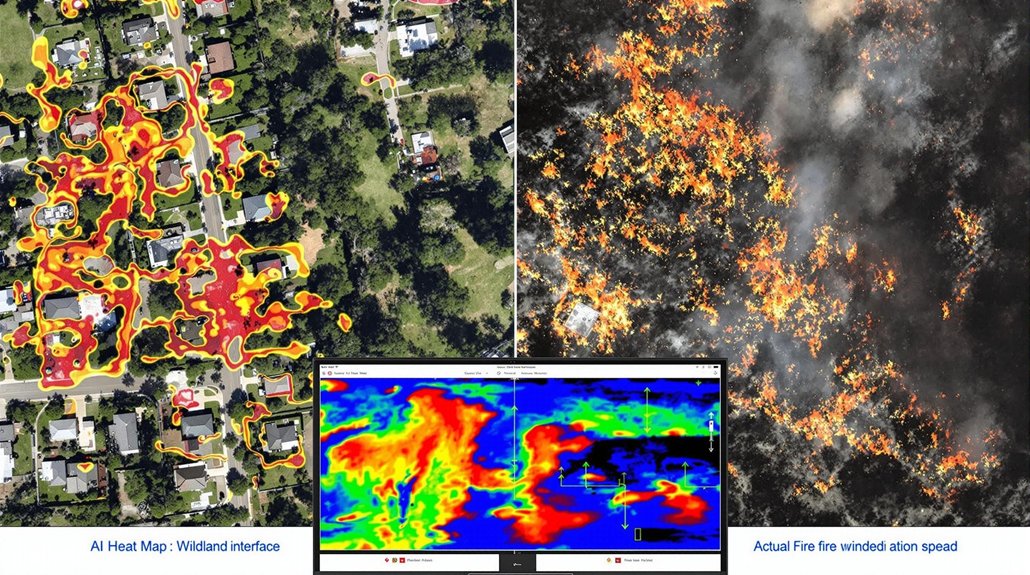

New AI wildfire simulators can now predict which homes are most likely to burn in future fires. Tools like FiReLine and Z-FIRE run millions of scenarios using historical fire data and satellite imagery. These systems help homeowners, insurance companies, and emergency planners prepare for disasters. Amica, an insurance company using Z-FIRE, reported a 95% reduction in California wildfire losses. These technologies offer vital insights as fire seasons become increasingly unpredictable.
As wildfires become increasingly destructive across the globe, scientists and technologists are turning to artificial intelligence for solutions. New AI wildfire simulation tools are emerging that can predict which homes are most likely to burn in future fires, giving homeowners, insurance companies, and emergency planners critical information to prepare for disasters.
Systems like FiReLine use reinforcement learning to simulate millions of wildfire scenarios in just hours. This technology has completed 100 million training steps in only 12 hours, allowing researchers to test countless variables that affect fire spread. The simulator integrates historical data on how humans have responded to past fires, making its predictions more realistic. FiReLine’s sophisticated algorithms combine projection modeling with data from the comprehensive BurnMD dataset, enhancing its ability to adapt to changing fire behaviors.
Z-FIRE combines property details with loss data to generate risk scores that have already shown impressive results. Insurance company Amica reports that Z-FIRE helped prevent 95% of wildfire losses in their California portfolio by identifying high-risk properties.
Another promising tool developed at USC merges generative AI with satellite imagery to forecast fire spread. This model successfully predicted fire paths during major California wildfires from 2020 to 2022. The USC researchers utilized a Conditional Wasserstein GAN that was trained to recognize patterns in satellite images linked to wildfire behavior.
Early detection systems like Pano AI use 360-degree cameras and real-time data analysis to spot fires when they first ignite, covering over 20 million acres across 15 states and provinces.
These AI simulators serve multiple purposes beyond predicting home destruction. They’re being used to design better forest management strategies, plan urban areas with effective firebreaks, improve insurance modeling, study climate change impacts, and educate policymakers.
Despite their advances, these systems face challenges. Their accuracy depends heavily on quality environmental data. Complex terrain and small weather changes can affect predictions, and false alarms remain problematic in areas where wilderness meets urban development.
The future of AI wildfire simulation looks promising. Researchers are working to integrate AI algorithms directly into satellites for orbit detection and developing AI assistants for building fire suppression strategies. As these technologies advance, they’ll provide even more accurate predictions of which properties face the highest risk.