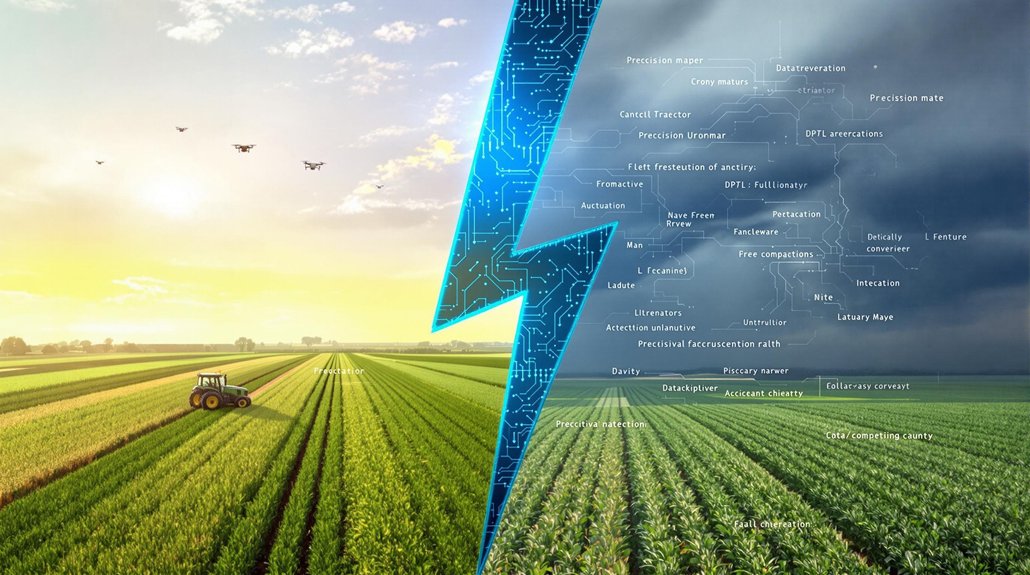

While farmers have been growing food for thousands of years without asking a computer for permission, AI is now muscling its way into agriculture like an uninvited tech bro at a barn raising. The numbers tell a story that’s both exciting and terrifying. The AI agriculture market is exploding toward $4.7 billion by 2028, growing at 23.1% annually. That’s real money chasing silicon dreams in cornfields.
The pitch sounds great. AI supposedly boosts crop yields by 25%, cuts pest losses in half, and predicts harvests with over 90% accuracy. Water efficiency jumps 80%. Fertilizer accuracy hits 85%. Pesticide use drops by up to 97%. Small farmers are seeing 120% returns on their AI investments, while big operations hit 150%. Digital agriculture could pump $450 billion annually into developing countries‘ agricultural GDP. These aren’t small potatoes. Beyond raw numbers, AI reduces economic uncertainty by up to 40%, helping farmers negotiate better crop insurance and loan conditions.
AI promises farming miracles: yields up 25%, pests halved, water use slashed 80%—but these aren’t small potatoes.
But here’s the rub. Only 20% of agribusinesses have actually gone all-in on AI, even though 80% admit it works. Why? Money, mostly. Technical know-how, definitely. The fear that some algorithm cooked up in Silicon Valley doesn’t understand Iowa soil? Probably that too. The adoption divide is stark: 81% of large farms with over 5,000 acres are willing to adopt AI, while only 36% of small farms under 2,000 acres plan to make the leap.
The robots are already here, handling the boring stuff—sowing, watering, harvesting. Drones buzz overhead checking crops. Software manages farms from smartphones. About 21% of farms use management software now, with 15% using precision tools and remote sensing. Manual labor needs are shrinking. That’s either progress or a problem, depending on who’s asking. Smart irrigation systems are becoming increasingly common, optimizing water usage while reducing operational costs.
AI’s also reshaping the business side. Predictive analytics help farmers guess market trends, manage inventory, and brace for weather disasters. Quality control gets sharper with AI cameras inspecting produce. Even crop insurance decisions get the algorithm treatment now.
The real worry isn’t whether AI works—it does. The concern is who gets left behind. Small farmers face financial and technical barriers that big operations don’t. Data privacy issues lurk. Algorithmic bias threatens fair treatment. Without serious collaboration between policymakers, businesses, and farmers themselves, this technological transformation could create a new class system in agriculture.
The gap between tech-savvy mega-farms and traditional smallholders might become a canyon. That’s the blessing and the threat, wrapped in one algorithmic package.
References
- https://www.startus-insights.com/innovators-guide/ai-in-agriculture-strategic-guide/
- https://www.omdena.com/blog/ai-for-crop-yield-prediction-future-agriculture-2025
- https://www.precisionfarmingdealer.com/articles/6440-how-ai-is-transforming-modern-agriculture-in-2025
- https://www.syngentagroup.com/newsroom/2025/five-key-trends-artificial-intelligence-will-revolutionize-agriculture-2025
- https://scoop.market.us/ai-in-agriculture-statistics/