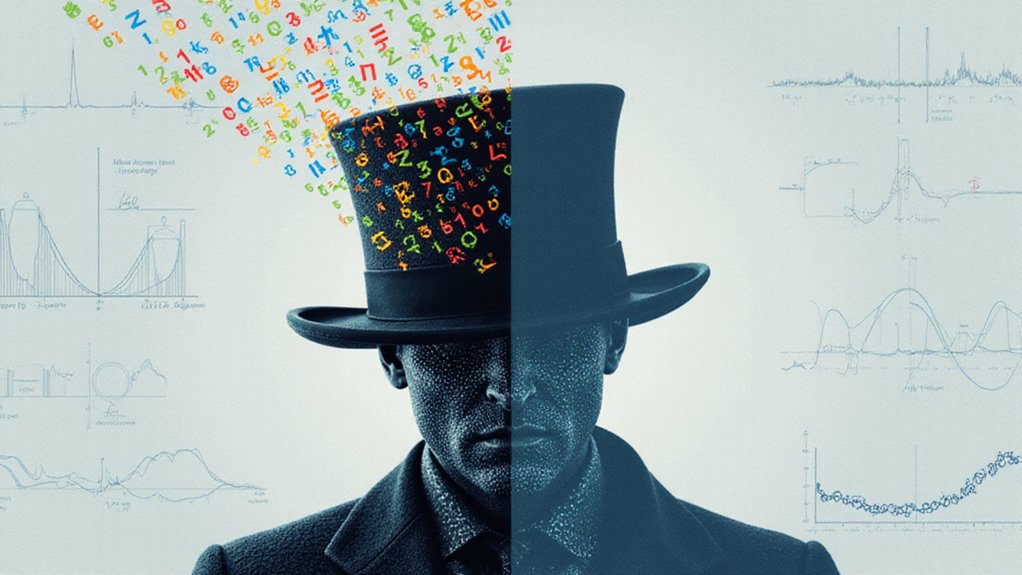

The magician pulls a rabbit from the hat, and everyone claps. Nobody asks if the rabbit understands why it’s there. That’s basically what’s happening with AI right now, according to researchers who are getting increasingly worried about our collective delusion.
Large language models don’t think. They predict. They’re statistical mimicry machines, churning through probability calculations to guess what word comes next. It’s pattern recognition on steroids, not reasoning. But damn, does it look convincing.
The distinction matters. When AI spits out something that sounds logical, it’s not because it worked through the problem. It matched patterns from its training data. That’s it. No comprehension, no understanding, just really sophisticated copying. Yet people treat these outputs like they came from some digital Einstein.
Statistical AI dominates the environment now. Deep learning models excel at handling messy, unstructured data – images, text, whatever. They find patterns humans would never spot. Meanwhile, the old-school symbolic AI approach, with its rules and logic structures, sits in the corner like a forgotten toy. Symbolic AI actually tries to model reasoning, manipulating concepts through explicit rules. Too bad it can’t handle the chaos of real-world data. Studies show that hallucinations occur in 3-27% of outputs, creating serious verification challenges for businesses and individuals alike.
Recent attempts to bridge this gap show promise. Large Reasoning Models aim to combine both approaches. Companies like OpenAI, Anthropic, and DeepSeek are training models specifically for reasoning tasks, generating chains of thought to solve problems step-by-step. These models rely on an inference engine powered by machine learning to analyze data and reach decisions. RTNet, for instance, uses stochastic processes to mimic how brains make decisions under uncertainty. In tests with visual noise, it matched human confidence ratings. Progress, maybe.
But here’s the kicker: even these advances don’t solve the fundamental problem. AI’s fluency creates a dangerous illusion. Users overtrust these systems, attributing genuine reasoning where none exists. The apparent logical inferences? Just statistical associations dressed up in a tuxedo.
Researchers keep sounding the alarm. These pattern-based systems can fail spectacularly when faced with situations outside their training distribution. They’ll produce nonsense with the same confidence they display when correct. No actual understanding means no ability to recognize their own mistakes.
The risk intensifies in high-stakes scenarios. Medical diagnosis, legal decisions, financial advice – areas where true comprehension matters. Yet the illusion persists, seductive and dangerous. The rabbit doesn’t understand the magic trick. Neither does the AI.
References
- https://www.science.org/doi/10.1126/science.adw5211
- https://www.ibm.com/think/topics/ai-reasoning
- https://www.visive.ai/news/ai-mimics-human-reasoning-a-groundbreaking-leap
- https://smythos.com/ai-agents/ai-agent-development/symbolic-ai-vs-statistical-ai/
- https://www.ve3.global/the-limits-of-ai-reasoning-beyond-the-illusion-of-intelligence/