California’s high-speed rail project is already reducing emissions before carrying passengers. Completed grade separations decrease vehicle idling at crossings, cutting greenhouse gases and local air pollution. The project includes $2.5 million for tree planting and requires cleaner construction equipment. Once operational, the system will use 100% renewable electricity and could reduce up to 1.7 million metric tons of emissions annually by 2040. Further environmental benefits await as construction progresses.
California’s ambitious high-speed rail project is expected to considerably reduce greenhouse gas emissions across the state. Estimates show the system will cut between 84 and 102 million metric tons of carbon dioxide equivalent during its first 50 years of operation. By 2040, the rail system is projected to reduce annual greenhouse gas emissions by 1.1 to 1.7 million metric tons compared to what would happen without the project.
California’s high-speed rail promises dramatic climate benefits, eliminating up to 102 million metric tons of emissions over five decades.
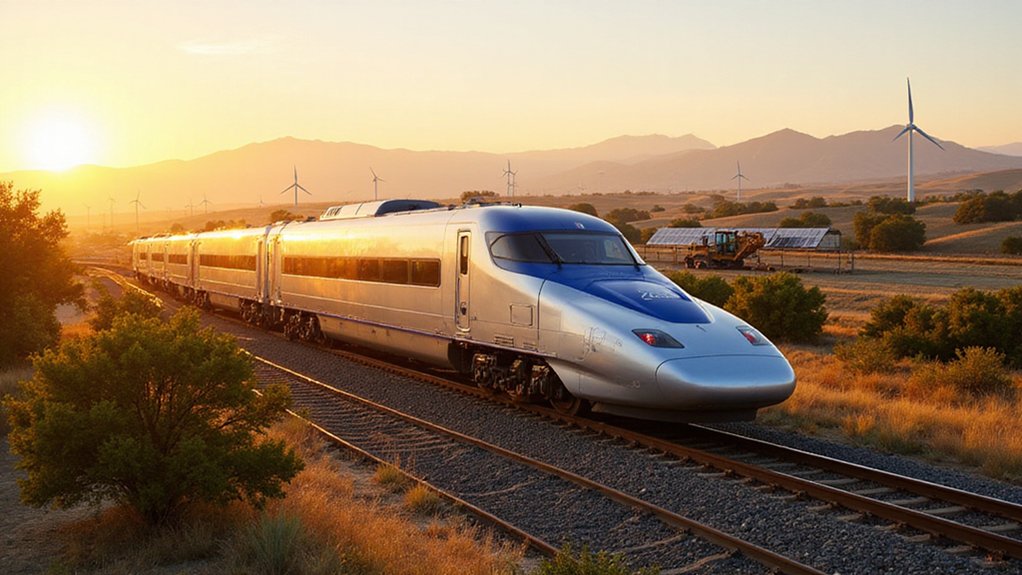
These climate benefits come from shifting travelers away from cars and planes to zero-emission trains. The rail authority has committed to using 100% renewable electricity for all train operations, ensuring the system will provide truly emission-free transportation. This commitment has been part of the project’s standards since 2008.
Even before carrying passengers, the project is already delivering environmental benefits. The completion of 18 grade separations has reduced vehicle idling at crossings, cutting both greenhouse gas emissions and local air pollution. These separations also improve traffic flow and eliminate the need for loud warning signals, reducing noise pollution.
During construction, the rail authority is taking steps to minimize its carbon footprint. It’s invested $2.5 million in tree planting grants to offset emissions from construction activities. The project also requires the use of cleaner construction equipment and practices to reduce on-site fuel use.
The high-speed rail system supports California’s broader climate goals for its transportation sector. It’s included in the California Air Resources Board‘s 2017 Scoping Plan as a central element for achieving the state’s emissions targets.
Beyond emissions reductions, the project brings additional environmental benefits. It includes measures to preserve agricultural lands and protect local ecosystems along the rail corridor. The authority publishes annual sustainability reports to track environmental progress. This project aligns with the growing trend of renewable energy investment which reached $303.5 billion globally in 2020.