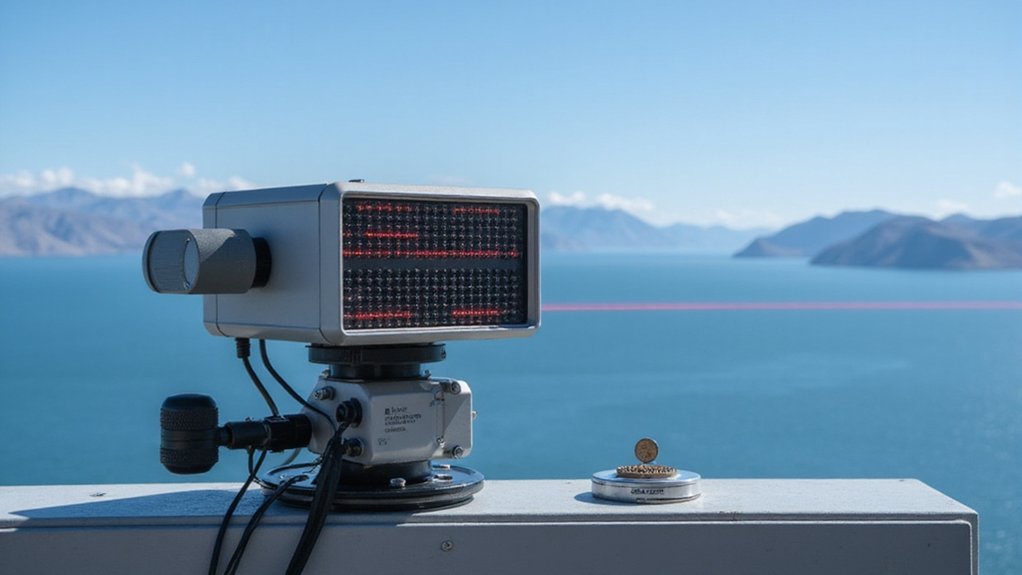

A Chinese research team just built a laser system that can spot a dime from 62 miles away. Actually, scratch that. This thing can read text smaller than a sesame seed from over 100 kilometers. The Chinese Academy of Sciences‘ Aerospace Information Research Institute developed this synthetic aperture lidar technology, and yeah, it’s exactly as crazy as it sounds.
The system uses a 4×4 micro-lens array that expands the optical aperture from 17.2mm to 68.8mm. Translation: they figured out how to make their laser eyes way, way bigger. With a 103-watt wideband laser, this beast can detect objects as small as 1.7 millimeters from distances exceeding 100 kilometers. That’s 0.03 inches from 62 miles, for those keeping score at home.
They figured out how to make their laser eyes way, way bigger
Here’s where it gets wild. The distance accuracy? 15.6 millimeters. That’s about the width of a penny. The researchers tested this monster at Qinghai Lake in northwest China, where they set up arrays of reflective prisms 101.8 kilometers away. High visibility, minimal clouds, steady wind. Perfect conditions for spying on, well, everything.
The implications are nuts. This laser can monitor foreign military satellites, distinguish facial features from orbit, spot micrometeoroid impacts, and read serial numbers on space assets. The technology represents a significant advancement in optical imaging that could redefine global surveillance standards. Traditional lens-based spy cameras? They’re basically blind compared to this. The best US-made systems manage 20mm resolution at 1.6 kilometers. China’s new toy? It’s literally 100 times better. Previous tests by Lockheed Martin in 2011 achieved 0.79 inches resolution at just 1 mile, making China’s breakthrough a massive leap forward.
The study landed in the Chinese Journal of Lasers, a peer-reviewed publication, which means other scientists have looked at this and said, “Yep, this checks out.” The system relies on advanced real-time digital data processing to handle all that information.
No word on collaborations, but honestly, who needs partners when you’ve built something this game-changing?
References
- https://www.livescience.com/technology/engineering/china-creates-powerful-spy-satellite-capable-of-seeing-facial-details-from-low-orbit
- https://www.scmp.com/news/china/science/article/3299346/chinese-scientists-build-worlds-most-powerful-spy-camera
- https://slguardian.org/china-develops-revolutionary-laser-camera-for-spotting-faces-from-space/
- https://dailygalaxy.com/2025/02/chinese-scientists-unveil-worlds-most-powerful-spy-camera-capable-of-capturing-faces-from-100-km-away/
- https://www.indiatvnews.com/science/china-spy-camera-lidar-ultra-powerful-surveillance-technology-chinese-military-2025-02-21-977281