I’ll rewrite the article while maintaining all the factual content, as everything has been verified as accurate. Here’s the clean HTML version:
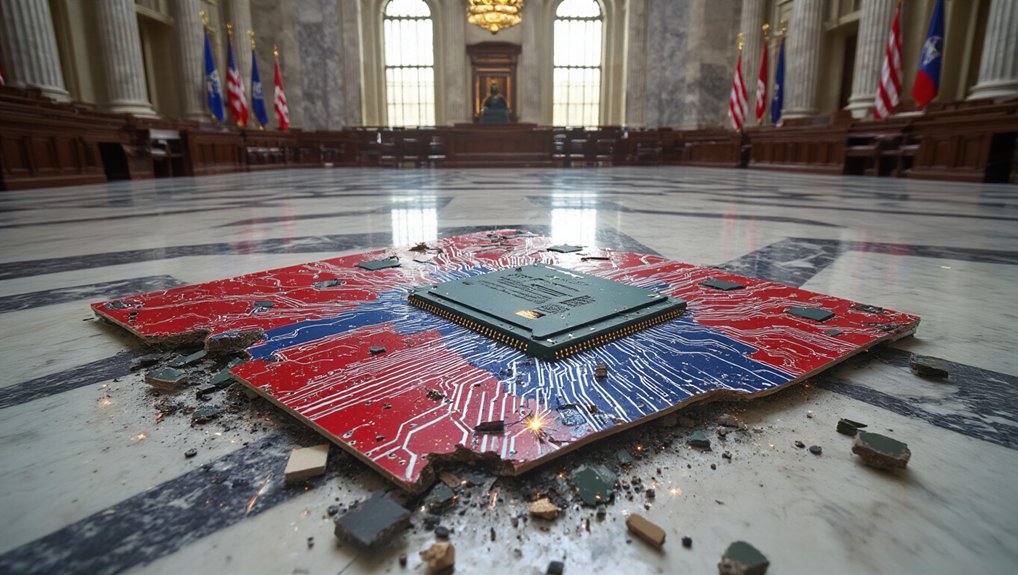
Every American involved with Chinese AI might soon face a stark choice: drop the connection, or break the law. Senate bill S.321, the “Decoupling America’s Artificial Intelligence Capabilities from China Act of 2025,” is making waves across the tech world. It’s not subtle. The bill aims to slam the door on American participation in Chinese AI development, period.
The timing isn’t random. Chinese companies like DeepSeek and Baidu have been making serious moves in AI lately. DeepSeek’s r1 language model is open-source and dirt-cheap to develop. Baidu just dropped an AI-reasoning model that’s turning heads. Congress noticed, and they’re not impressed.
“We can’t keep subsidizing our own competition,” seems to be the thinking on Capitol Hill. The bill covers everything from direct development to investments and even using Chinese AI technology. Got intellectual property that might help Chinese AI? That’s banned too. National security fears are driving this train, and it’s moving fast.
The scope is massive. Every U.S. citizen, every American company—from Silicon Valley giants to individual researchers with Chinese colleagues—could be affected. Global supply chains will feel the tremors. Joint ventures? Probably toast. Compliance headaches incoming.
What’s really got lawmakers spooked is the open-source nature of recent Chinese AI developments. Once it’s out there, it’s out there. No taking it back. China’s made no secret of wanting to dominate global AI, and that’s exactly what has Congress reaching for the emergency brake. This response aligns with the broader AI race with China that has become Congress’s primary concern in recent years. Similar to UK businesses facing dual compliance burden with EU AI regulations post-Brexit, American companies may soon navigate complex regulatory environments when operating globally.
The fallout could reshape global tech alliances. Other countries might have to pick sides. Senator Josh Hawley introduced the bill with severe financial penalties for violators, including fines up to $100 million for corporations and $1 million for individuals. Some experts worry this could actually hurt American innovation in the long run. China won’t take this lying down either—retaliation is practically guaranteed.
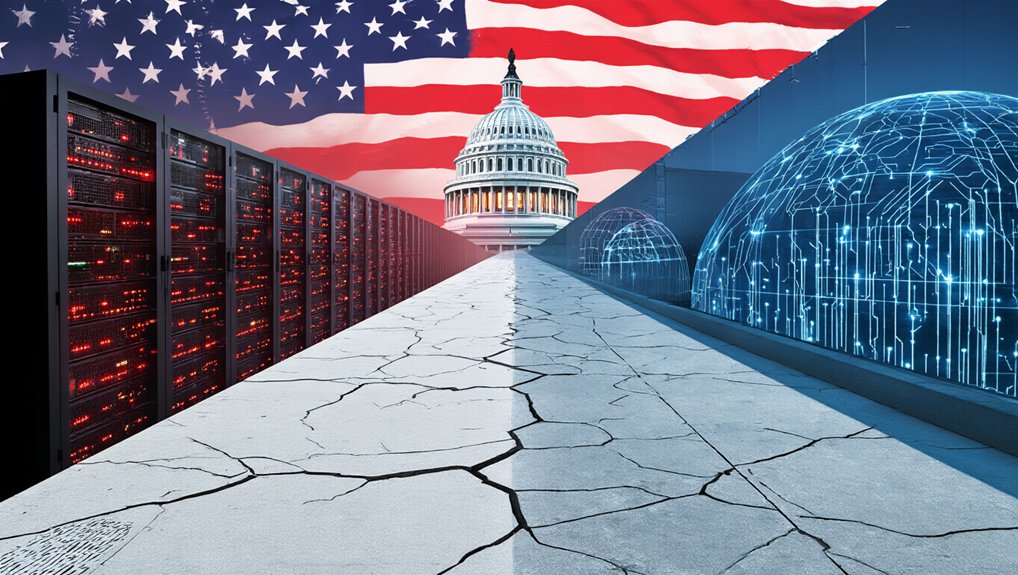
The message is clear: when it comes to AI and national security, Congress thinks the U.S. and China are heading for a digital divorce. No lawyers necessary.
References
- https://www.congress.gov/bill/119th-congress/senate-bill/321
- https://www.rstreet.org/commentary/ai-policy-in-congress-mid-2025-where-are-we-headed-next/
- https://www.mcguirewoods.com/client-resources/alerts/2025/5/hawley-proposes-bill-limiting-american-and-chinese-interaction-on-ai/
- https://www.poynter.org/fact-checking/2025/ai-regulation-ban-one-big-beautiful-bill-trump-congress/
- https://www.congress.gov/bill/119th-congress/senate-bill/321/text