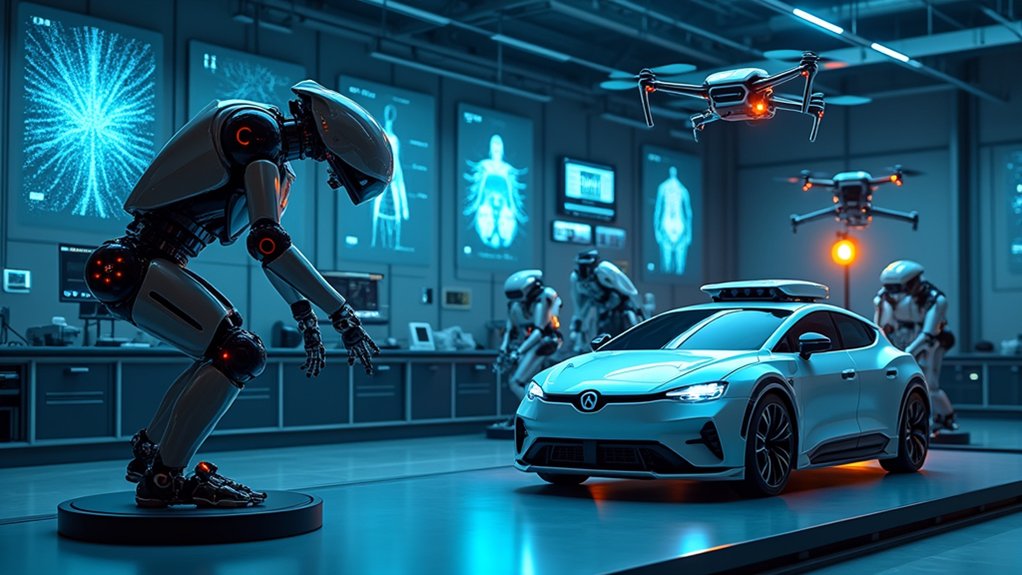

Recent AI developments include workplace AI agents acting as virtual co-workers, multimodal systems that process text, images, and audio simultaneously, and healthcare applications with potential cost savings of $360 billion by 2030. Business AI optimization is bringing returns for 70% of organizations, while national security applications are expanding. Companies are increasing AI investments, with 92% planning to boost spending over the next three years. The full scope of these advancements reveals a transforming technological landscape.

As the world enters 2025, artificial intelligence is transforming from a buzzword into practical tools with real-world impact. AI agents are gaining traction across industries, functioning like virtual co-workers that can independently handle complex tasks from scheduling meetings to writing software. Salesforce's Agentforce platform is making it easier for companies to deploy these AI assistants in their workflows. With 92% of companies planning to increase AI investments over the next three years, these agents will become increasingly prevalent in the workplace.
Multimodal AI systems are becoming more common, with models like Google's Gemini and OpenAI's GPT-4V processing text, images, and audio together. These systems show improved contextual understanding during long conversations and can integrate real-time data for better personalization. Developers now have greater API access to build with these multimodal capabilities. The rise of agentic AI represents a significant advancement in autonomous systems that can manage workflows without human intervention.
AI's evolution from single-sense to multimodal capabilities marks a pivotal shift toward more human-like digital interaction.
The healthcare sector is experiencing significant AI adoption. About 25% of healthcare tasks could be automated by AI, with potential cost savings reaching $360 billion annually by 2030. Over 650 AI-powered medical devices have received FDA approval. These technologies help create precision medicine approaches by analyzing patient data for personalized treatments. Emerging interactive narrative AI is creating personalized healthcare education that adapts based on patient responses and comprehension levels.
For businesses, 2025 is being called the year of AI optimization. With 70% of organizations already reporting returns on their AI investments, companies are now focused on maximizing value from these technologies. This includes improvements at both hardware and software levels, and carefully matching AI models to specific business needs.
National security applications for AI are expanding rapidly. The US military has launched initiatives like the Replicator program and AI Rapid Capabilities Cell. AI companies are forming partnerships with defense contractors, including OpenAI's collaboration with Anduril on drone defense systems.
The growth of generative AI has renewed focus on managing unstructured data like text, images, and video. About 94% of data leaders report increased attention to data management, with many implementing retrieval-augmented generation systems to access information more effectively.
Infrastructure development for AI is getting government support through Executive Order 14141, which promotes US leadership in AI through land leasing for data centers and energy grid improvements.
Frequently Asked Questions
How Will AI Impact Job Security in Traditional Industries?
AI will greatly disrupt traditional industries across sectors.
Manufacturing could see 30% of tasks automated by 2030, with 20 million jobs displaced globally.
In offices, 85% of customer service interactions may be handled by AI chatbots by 2025.
Creative industries face similar challenges, with AI potentially replacing 30% of journalist tasks.
Healthcare isn't immune either, as AI diagnostic tools may impact 30% of radiologist work.
What Ethical Concerns Surround Advanced AI Systems?
Advanced AI systems raise several key ethical concerns. They can reinforce biases in data, leading to discrimination against minorities.
Privacy issues emerge as AI collects vast amounts of personal information.
Many AI systems operate as "black boxes," making their decisions difficult to understand or challenge.
There's also worry about diminishing human control, especially in critical areas like healthcare or warfare.
Are There International Regulations Governing AI Development?
International AI regulations are developing but remain fragmented.
The EU leads with its extensive AI Act, while the US relies on an Executive Order. China has implemented measures for generative AI, and the UK follows a sector-specific approach.
Global initiatives include the OECD AI Principles, UNESCO's Ethics Recommendation, and ISO/IEC technical standards.
Challenges persist in balancing innovation with ethical concerns and harmonizing diverse regulatory approaches across borders.
How Accessible Is Cutting-Edge AI Technology to Small Businesses?
Cutting-edge AI is becoming more accessible to small businesses through cloud-based services with pay-as-you-go pricing.
No-code platforms now allow non-technical users to implement AI solutions. Industry-specific tools for marketing, customer service, and accounting are available at various price points.
However, challenges remain, with 45% of SMBs citing lack of technical expertise and 38% struggling with costs as adoption barriers.
What Safeguards Exist Against AI Systems Becoming Uncontrollable?
Multiple safeguards protect against uncontrollable AI systems.
Technical measures include formal verification methods, reward modeling, and kill switches for emergency shutdowns.
Governance relies on ethics boards, third-party audits, and government regulations.
Testing involves controlled environments and red team exercises to find weaknesses.
Continuous monitoring tracks AI behavior for unusual patterns.
These layers of protection work together to guarantee AI systems remain under human control.