
Three years. That’s how long it took Apple to race from ChatGPT-induced panic to launching Apple Intelligence. The famously secretive tech giant wasn’t about to let OpenAI steal its thunder. No way.
Apple’s lightning-fast pivot from AI laggard to innovator shows just how seriously they took the threat from OpenAI.
After years of quiet AI work focused on Siri and camera features, Apple suddenly found itself playing catch-up in 2022.
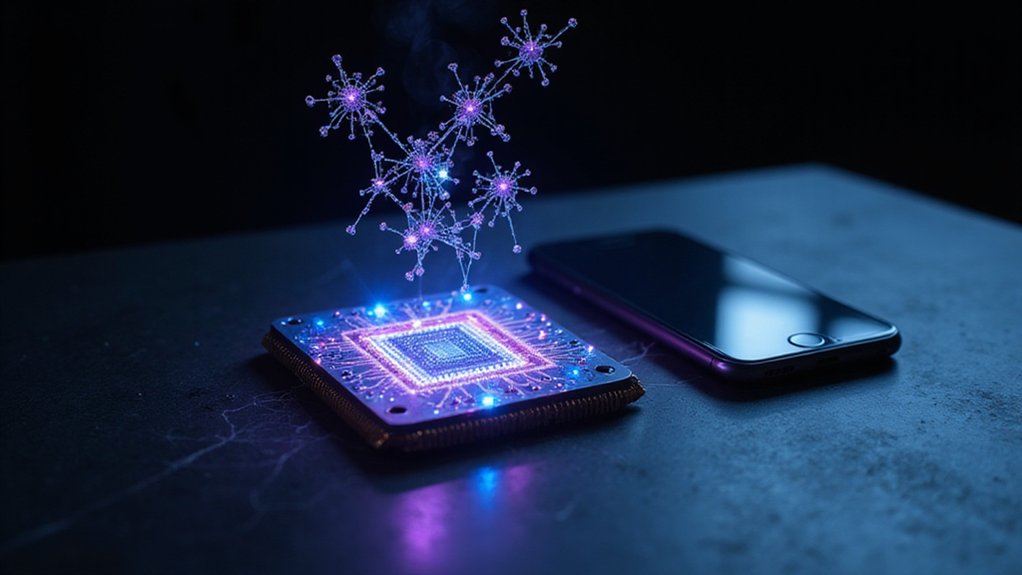
The company was building AI muscles long before that, though. Remember 2017? While everyone drooled over the iPhone X’s missing home button, the real transformation was happening inside – the A11 Bionic chip with its Neural Engine.
Face ID, Animoji, those eerily perfect portrait photos? All powered by on-device AI when competitors were sending everything to the cloud.
Apple’s approach was different from day one. They weren’t interested in chatbots that needed constant internet connections. They wanted AI that lived in your pocket, processing data right there on your device.
Privacy obsession? Sure. But also practical. No waiting for server responses. No sharing your secrets with the data-hungry tech overlords.
Then ChatGPT dropped and changed everything. Apple scrambled, launching “Ajax” – their own large language model project. The result? A surprisingly compact 3-billion parameter model that powers Apple Intelligence.
For comparison, that’s tiny compared to GPT-4’s rumored trillion-plus parameters. But size isn’t everything in AI.
Tim Cook bet big, redirecting massive resources toward AI in 2024. The payoff? An integrated system that enhances existing apps rather than existing as a standalone novelty. Smart, actually.
The Neural Engine’s evolution across chip generations made this possible. Each iPhone got exponentially better at AI tasks without sacrificing battery life or privacy. No small feat.
Apple’s AI transformation wasn’t flashy until recently. It was methodical. Intentional. Built piece by piece over a decade.
From Siri’s awkward debut on the iPhone 4S to the sophisticated Apple Intelligence system rolling out today. Not bad for a company that nearly missed the AI boat entirely. Their on-device foundation model has impressively outperformed small models from competitors like Mistral AI, Microsoft, and Google.
Apple incorporated machine learning algorithms similar to those revolutionizing healthcare diagnosis to improve their device capabilities and user experience.
The Smart HDR feature, introduced with iPhone XS and XS Max in 2018, revolutionized smartphone photography by leveraging the A12 Bionic chip to analyze multiple exposures simultaneously and create stunning photos with remarkable dynamic range.
References
- https://en.wikipedia.org/wiki/Apple_Intelligence
- https://www.digit.in/features/mobile-phones/a-timeline-of-ai-features-on-apple-iphone-the-past-and-the-present.html
- https://www.techtarget.com/searchenterpriseai/tip/The-history-of-artificial-intelligence-Complete-AI-timeline
- https://www.brandvm.com/post/iphone-evolution-history-timeline
- https://www.coursera.org/articles/history-of-ai