
Nearly every corner of the global economy is being transformed by artificial intelligence, with tech giants leading an unprecedented investment boom. Global hyperscalers are projected to spend more than $450 billion on AI-related capital expenditures in 2025, with Evercore forecasts suggesting this figure could reach $600 billion by 2026.
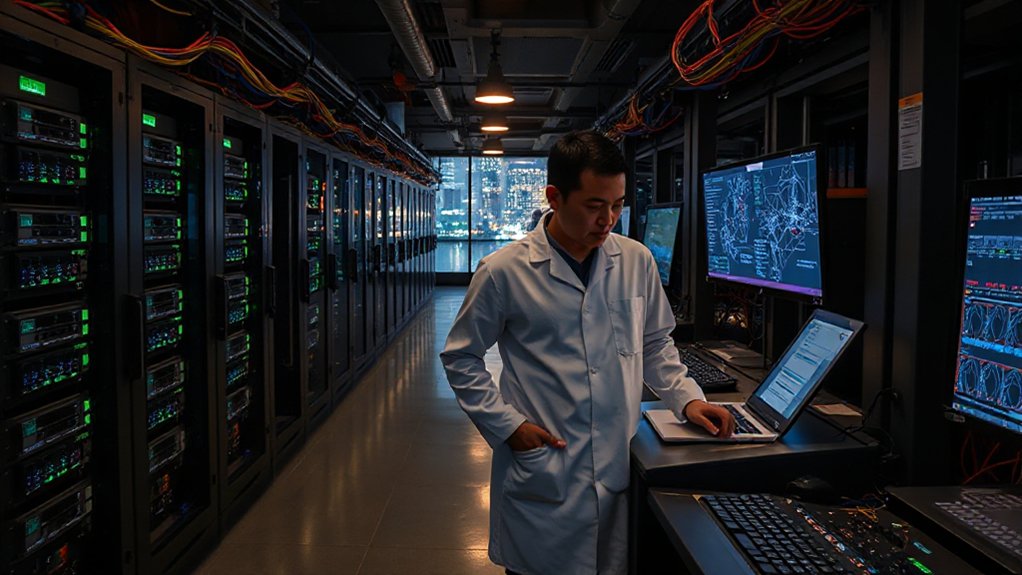
This massive spending is primarily directed toward data centers, cutting-edge chips, networking, and supporting systems. Tech companies are allocating tens of billions for new campuses equipped with advanced semiconductors, dense optical networking, and sophisticated cooling systems. This investment cycle mirrors the scale and importance of the 1960s space race in terms of infrastructure development and technological advancement. However, investors should remain cautious as every tech boom eventually experiences a significant market correction.
In the semiconductor market, NVIDIA has emerged as the clear early winner in AI accelerator demand. GPU demand far exceeds available supply, allowing NVIDIA to maintain gross margins in the 70s with robust cash flow. Year-long order backlogs are driving extraordinary earnings growth for semiconductor leaders.
Enterprise co-pilots are becoming standard across productivity suites. AI is enabling capabilities previously considered impossible, including legal document drafting, complex code debugging, and multi-step problem reasoning. Large tech firms report substantial savings from reducing back-office staff and embedding AI tools. The rise of multimodal AI systems like Google’s Gemini and OpenAI’s GPT-4V has dramatically improved these tools’ ability to process various data types simultaneously.
The AI boom is creating a “power renaissance” as companies race to build mega-scale data centers. Latest AI models designed for reasoning require much higher compute intensity than earlier versions. Developers need vast computational power to train, run, and scale next-generation AI models.
The “Magnificent Seven” stocks—NVIDIA, Microsoft, Apple, Alphabet, Amazon, Meta, and Tesla—now comprise about one-third of S&P 500 value. These companies are posting earnings growth in the mid-20% range compared to flat or single-digit growth for the rest of the S&P 500.
According to Fidelity Asset Allocation Research Team estimates, the AI boom accounts for roughly 60% of recent economic growth. As the technology continues to mature, companies are moving beyond traditional benchmarks to evaluate AI through real-world applications, seeking systems that deliver practical results rather than just impressive technical specifications.
References
- https://fundlibrary.com/Articles/Detail/the-big-tech-story-for-2026-the-ai-revolution/2094
- https://investorplace.com/market360/2025/12/is-2026-a-tipping-point-for-the-ai-revolution/
- https://www.fidelity.com/learning-center/trading-investing/AI-outlook
- https://www.nasdaq.com/articles/gpus-are-so-2025-2026s-hottest-trend-157-trillion-artificial-intelligence-revolution
- https://www.jpmorgan.com/content/dam/jpmorgan/documents/wealth-management/outlook-2026.pdf
- https://hai.stanford.edu/news/stanford-ai-experts-predict-what-will-happen-in-2026