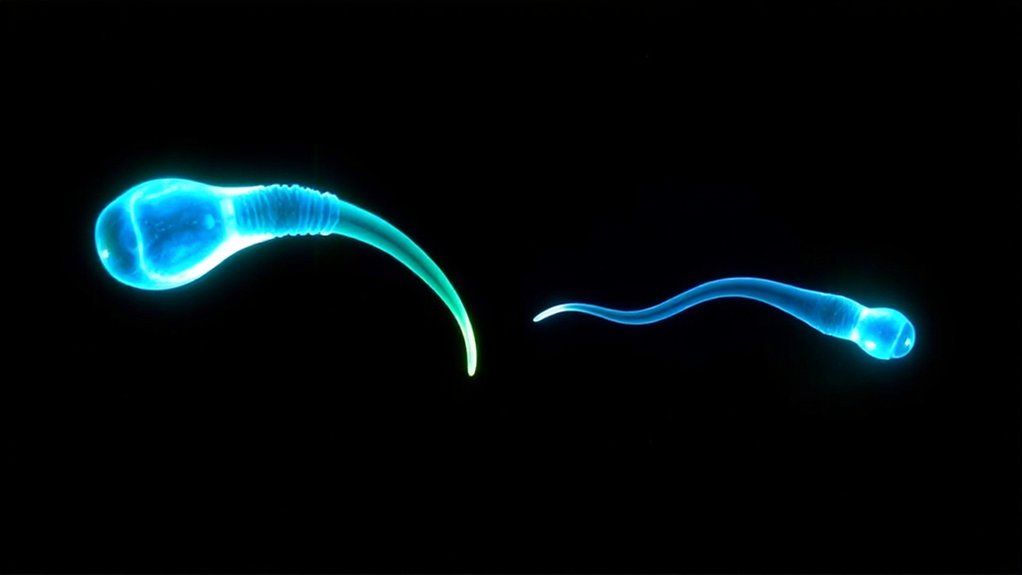

Revolutionary artificial intelligence technology has successfully detected previously invisible sperm cells, leading to the first reported pregnancy from this breakthrough method. After 19 years of trying to conceive, a couple has achieved pregnancy thanks to the STAR (Sperm Tracking and Recovery) system developed by Columbia University researchers.
The AI system found viable sperm cells that were completely missed by traditional laboratory methods. For men with non-obstructive azoospermia, a condition where sperm appear absent in semen samples, this technology offers new hope.
The STAR system combines AI with microfluidic technology to scan semen samples in real time. It can process over 2.5 million microscopic images within about two hours. The AI algorithm spots rare sperm cells hidden among cellular debris that human technicians can’t see due to their tiny size. The AI confirms detection by tracking sperm across ten consecutive frames to minimize false positives.
When the AI detects sperm, it flags that portion of the sample for collection. In the groundbreaking case reported in 2025, Columbia University Fertility Center recovered two motile sperm using this method. These sperm were used for intracytoplasmic sperm injection (ICSI), creating two viable embryos.
After transferring an embryo on day 3, doctors confirmed a clinical pregnancy. An ultrasound at 8 weeks showed a normal fetal heartbeat. This success came after multiple failed IVF cycles and surgical sperm retrieval attempts over nearly two decades.
Male factors contribute to about 40% of infertility cases, with azoospermia accounting for roughly 10%. Traditional manual searches often fail to find viable sperm in these patients, limiting reproductive options to donor sperm or invasive procedures with low success rates.
Columbia University researchers spent five years developing the STAR AI system. The technology rapidly processes images at speeds impossible for humans, reducing sperm identification time from hours to minutes. This advancement addresses what Dr. Zev Williams describes as the challenging and frustrating process of microscopic searches that often yield no results. It’s now being integrated into laboratory workflows, standardizing and accelerating the assessment of rare sperm presence.
References
- https://studyfinds.org/ai-detects-invisible-sperm/
- https://www.thedailyjagran.com/technology/ai-helps-couple-conceive-after-20-years-of-infertility-a-medical-breakthrough-from-columbia-university-10277754
- https://www.femtechworld.co.uk/news/fertility-news/doctors-report-first-pregnancy-using-ai-system-to-detect-sperm-in-men-previously-considered-infertile-aift25/
- https://interestingengineering.com/culture/ai-star-system-pregnancy-after-18-year
- https://pubmed.ncbi.nlm.nih.gov/38652944/
- https://economictimes.com/news/india/how-ai-helped-an-infertile-couple-conceive-after-19-years-with-just-2-sperm/articleshow/125051307.cms