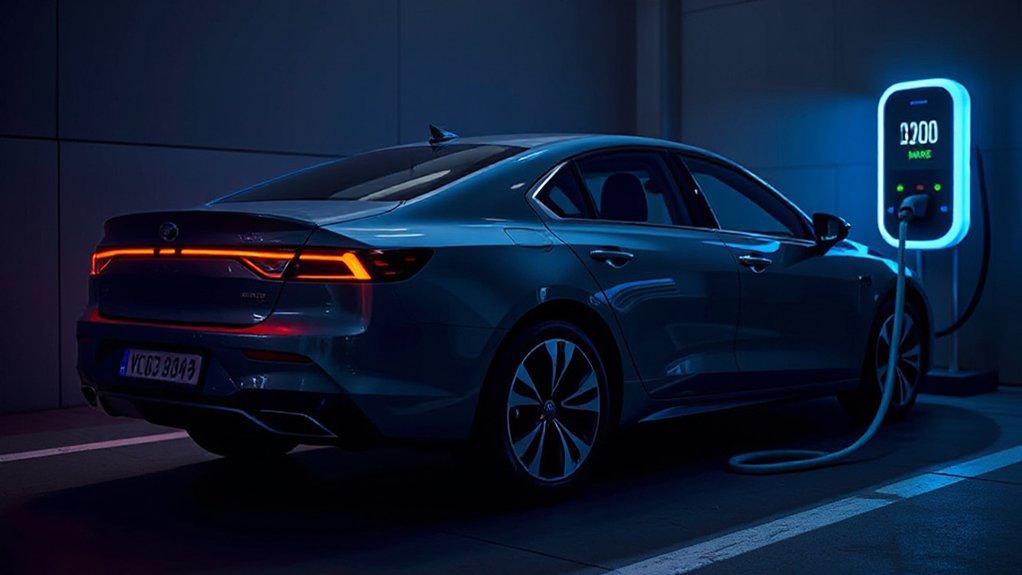
While electric vehicles continue to gain popularity, a wave of breakthrough battery technologies is now promising to quadruple energy density. Researchers and manufacturers are making rapid advances that could soon extend EV driving ranges to 1,000 miles or more. This development might eliminate the “range anxiety” that has concerned many potential EV buyers.
CATL Developments has achieved energy densities over 300 Wh/kg working with GM and Tesla. These high-density packs could double driving ranges without increasing battery size. Experts predict these advances may enable 1,000-mile EVs within the decade.
Battery innovation leaps forward as CATL achieves 300+ Wh/kg density, potentially doubling EV ranges within years.
Huawei’s prototype solid-state battery pushes energy density even further, reaching 400-500 Wh/kg. This breakthrough could deliver an impressive 1,800 miles of range and charge in under five minutes. Though questions about mass production remain, the prototype shows the industry’s direction.
Toyota’s copper nitride cathode technology offers double the capacity of standard lithium-ion cathodes. With a 550 mAh/g capacity, this innovation could increase EV range from 372 to 745 miles. Toyota expects to deploy this technology in the near future.
The Fraunhofer Institute has created a solid-state lithium-sulfur battery exceeding 600 Wh/kg, nearly twice the density of typical lithium-ion batteries. Their Dtraec process reduces production energy by 30% while ensuring durability for over 186,000 miles. The power demands from these advanced batteries could challenge grid infrastructure as their adoption increases, similar to how AI data centers are creating severe power distortions in regions with high technological concentration.
Stellantis and Factorial have validated their FEST cells at 375 Wh/kg. These 77Ah cells can charge from 15% to 90% in just 18 minutes and operate in temperatures from -30°C to 45°C.
Solid-state batteries offer 300-500 Wh/kg and can endure 8,000-10,000 charge cycles. By replacing liquid electrolytes, these batteries enhance safety by reducing thermal runaway risks. Goldman Sachs projects a 50% price drop in EV battery costs by the end of 2025, which could accelerate adoption of these advanced technologies. Recent advancements like the YASA prototype demonstrate how in-wheel motors with extreme power density can complement these battery innovations for next-generation EVs.
Other innovations include LG’s high-nickel NCMA batteries, CTP technology boosting density by 5%, and 24M’s electrolyte enabling four times faster charging. These advances signal a new era where EV range concerns may soon become a thing of the past.
References
- https://www.power.com/community/green-room/blog/electric-vehicle-batteries-2025-redefining-road-ahead
- https://interestingengineering.com/energy/top-7-ev-stories-of-2025
- https://www.stellantis.com/en/news/press-releases/2025/april/stellantis-and-factorial-energy-reach-key-milestone-in-solid-state-battery-development
- https://www.large-battery.com/blog/electric-vehicles-lithium-battery-advancements-2025/
- https://inside.lgensol.com/en/2025/06/the-heart-of-evs-the-present-and-future-of-secondary-batteries/
- https://www.youtube.com/watch?v=DK_hOnvU3l8
- https://www.quantumscape.com/battery-technology/
- https://electrek.co/2025/12/23/solid-state-ev-battery-maker-going-public-after-745-mile-test/