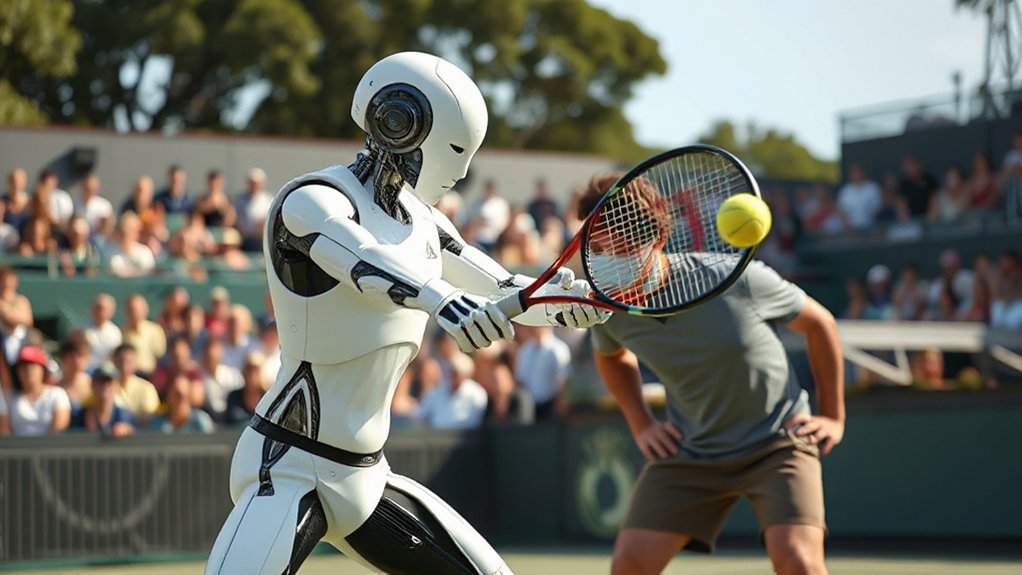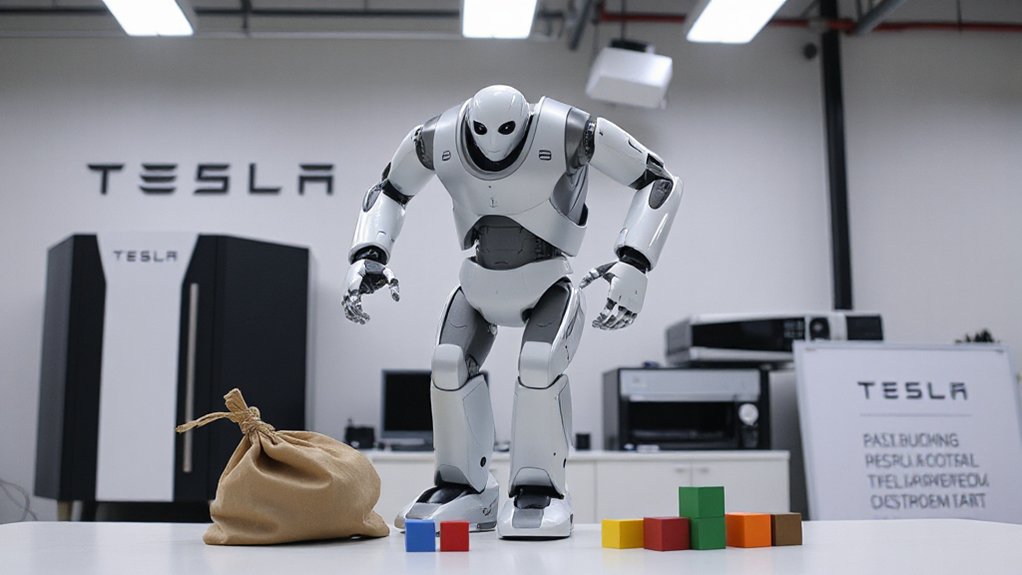
Tesla’s humanoid robot Optimus struggled to perform basic tasks during a recent demonstration, highlighting significant challenges in its development. The robot had trouble with simple object manipulation, requiring multiple attempts to pick up a bag and sort blocks. Video footage showed the robot moving with notable instability and uncoordinated hand movements.
Audience members watched awkwardly as Optimus performed slow, hesitant arm motions during simple activities. The demonstration revealed several technical issues in real-time, including problems with grip accuracy and jerky movement corrections. Despite ambitions to deploy 5,000-10,000 units in 2025, the current generation appears far from production-ready.
Standing 5’8″ tall and weighing 125 pounds, Optimus was designed with 28 degrees of liberty, including 11 in the hands for dexterity. The robot runs on a 2.3 kWh battery that should allow for all-day operation in theory. The company encountered major design issues that led to a production halt for significant redesign of the Optimus Gen 3. Despite being made of metal and lightweight plastics, balance optimization remains a work in progress.
The robot’s autonomous functioning is still limited, with most actions being pre-programmed or remotely supervised. Real-time AI decision-making for complex tasks is still under development. Optimus relies on Tesla’s Autopilot hardware and neural network platform, along with simulation-trained reinforcement learning.
Robotics experts have expressed skepticism about Optimus’s readiness for real-world deployment. While some praised the progress in basic balance and gait, they noted significant gaps in manipulation skills and adaptability. Media coverage often points out the contrast between Elon Musk’s ambitious vision and the robot’s actual performance.
Tesla plans to use Optimus first in industrial settings rather than homes due to reliability concerns. The company will trial the robots internally through 2025, with possible business deployment by 2026. Consumer applications have been postponed until technical issues are resolved.
Optimus currently struggles with unstructured, dynamic environments. It relies heavily on mapped human motions for imitation and has difficulty handling unexpected variables. The recent demonstration underscored the significant gap between simulation-based training and real-world adaptability.
References
- https://briandcolwell.com/a-complete-review-of-teslas-optimus-robot/
- https://ts2.tech/en/tesla-optimus-gen-3-inside-the-humanoid-robot-revolutionizing-industry/
- https://builtin.com/robotics/tesla-robot
- https://www.compassitc.com/blog/optimus-robots-a-new-attack-surface-for-hackers
- https://www.birow.com/tesla-optimus