
While many feared that artificial intelligence might replace medical specialists, radiologists are finding that AI has become their most valuable partner. With over 700 AI tools approved by the FDA specifically for radiology, these technologies are now commonplace in imaging departments across the country. Rather than threatening jobs, AI is helping radiologists work better and faster.
Recent studies show that when radiologists team up with AI, they find more diseases than either could detect alone. The AI catches patterns that human eyes might miss, while radiologists provide critical judgment that machines lack. This partnership leads to more accurate diagnoses for patients and fewer missed conditions.
When humans and algorithms join forces, patients win through superior detection rates and fewer diagnostic errors.
Radiologists aren’t just maintaining their positions – they’re evolving into more valuable roles. As AI handles routine tasks like initial screenings and pattern recognition, doctors can focus on complex cases and spend more time with patients. This shift has boosted job satisfaction while maintaining job security in the field.
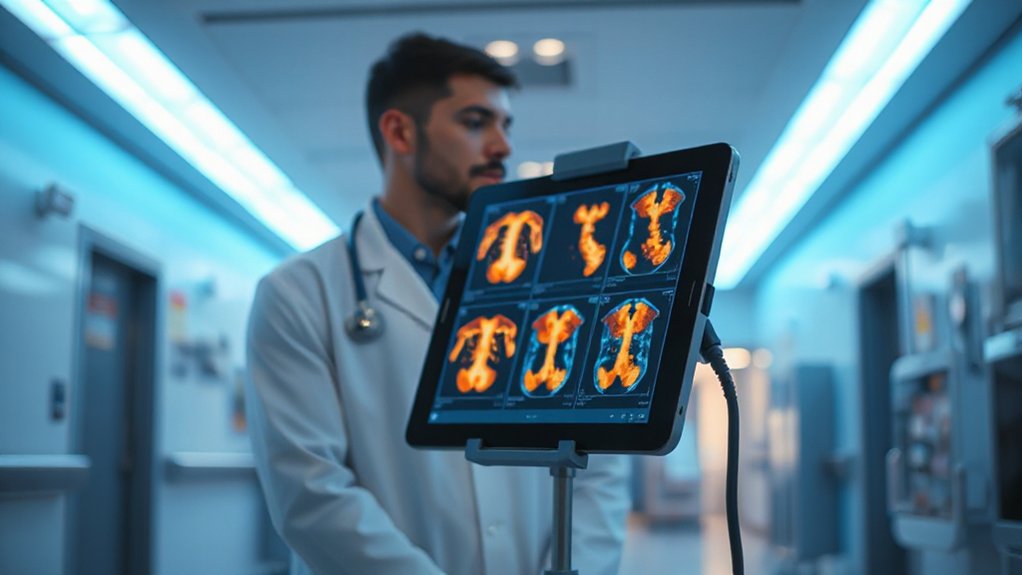
The numbers back up this positive trend. Over 340 imaging AI algorithms have already received regulatory clearance in the U.S., showing how quickly these tools are becoming essential. Hospitals using AI report faster results for patients and less burnout among doctors, as the technology takes over repetitive analysis tasks. Computer vision technology has revolutionized how radiologists examine and interpret medical scans, providing unprecedented accuracy and efficiency.
Research with hundreds of radiologists confirms that AI collaboration improves both speed and accuracy. When working with AI on the Collab-CXR dataset, radiologists made better diagnoses than they could on their own. They also processed more images in less time, reducing patient wait times.
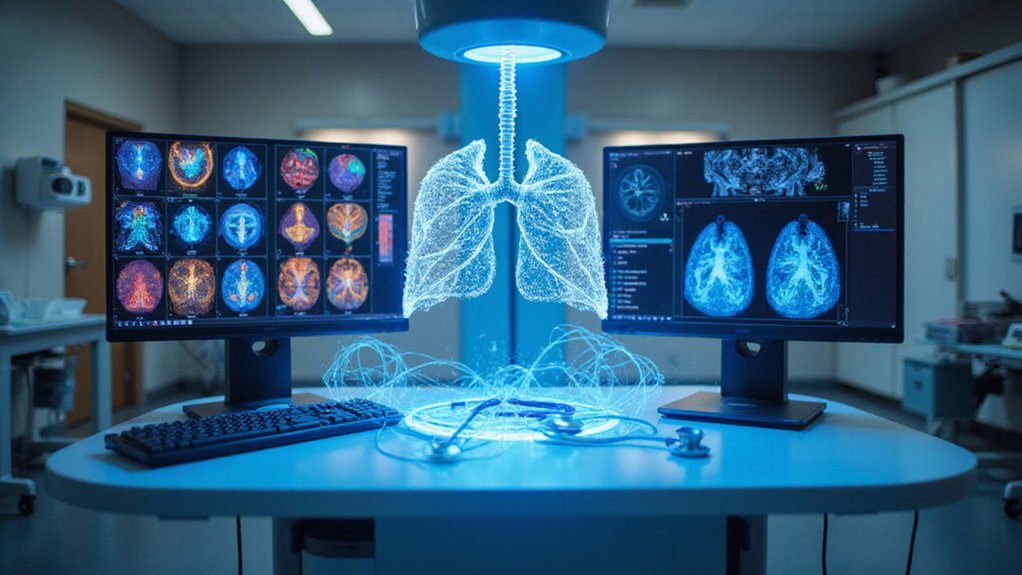
Far from replacing radiologists, AI is creating new opportunities for them to grow professionally. Many are developing technical skills to better work with these systems, while others are taking on roles supervising and improving AI performance. This trend comes at a critical time as the U.S. faces a projected shortage of up to 42,000 radiologists by 2033. Task-specific AI detectors now serve as a second set of eyes for radiologists, highlighting subtle findings that might otherwise be missed.
As radiology departments adopt more AI tools, they’re hiring more specialists, not fewer, to manage these powerful new capabilities.
References
- https://www.azmed.co/news-post/ai-radiology-impact-practice
- https://radiologybusiness.com/topics/healthcare-management/mergers-and-acquisitions/radiology-ma-expert-shares-6-trends-watch-2025
- https://www.radiologytoday.net/archive/rt_MAY25p18.shtml
- https://hms.harvard.edu/news/does-ai-help-or-hurt-human-radiologists-performance-depends-doctor
- https://pubmed.ncbi.nlm.nih.gov/40319039/