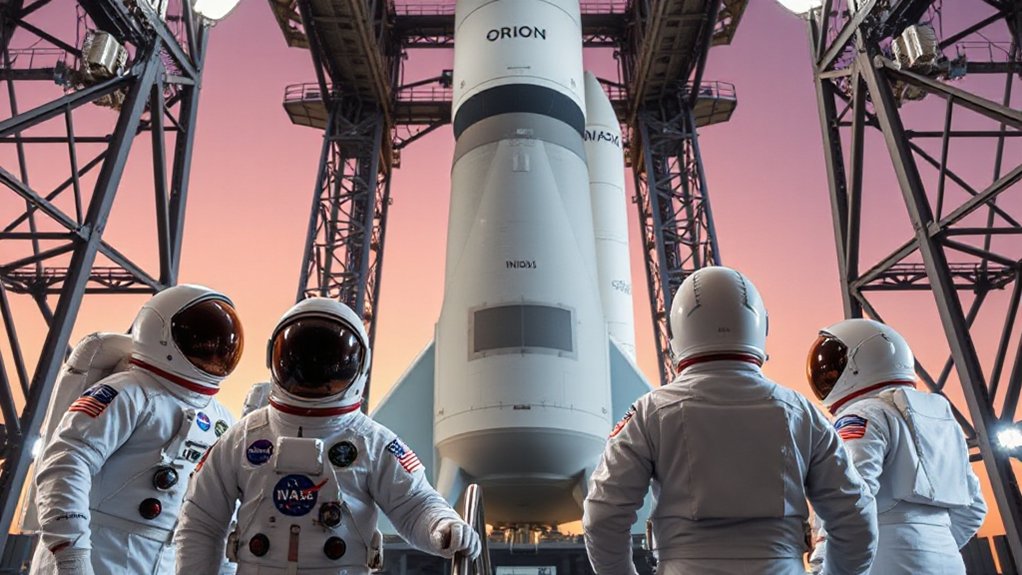
When NASA sends four astronauts around the Moon on Artemis II, it’ll mark a major step in humanity’s push into deep space. The mission won’t include a lunar landing. Instead, the crew will loop around the Moon’s far side on a free-return trajectory and come back to Earth in about 10 days.
It’s the first crewed Artemis flight, coming after the uncrewed Artemis I mission in 2022. The crew will ride inside NASA’s Orion spacecraft, launched by the Space Launch System. That rocket produces 15% more thrust than the Saturn V, which carried Apollo astronauts to the Moon decades ago.
The astronauts won’t just be passengers. They’ll manually operate the spacecraft, monitor automated systems, and test life support, propulsion, power, and navigation systems. They’ll also practice proximity operations and study how well the spacecraft fits human needs during long trips.
The Artemis II crew will manually fly the spacecraft, test critical systems, and assess how well Orion supports human needs.
One big goal is proving that humans can survive in deep space. Beyond Earth’s magnetic field, astronauts face higher radiation levels and other dangers not present in low Earth orbit. Artemis II will help NASA understand how people hold up in that environment.
The European Service Module plays a key role. It handles life support, power, and propulsion for the Orion capsule. Engineers need to confirm it works well enough to support future, longer missions.
The mission also tests emergency systems. That includes launch day crew rescue, abort automation, and post-splashdown recovery. NASA wants to make sure it can get astronauts home safely if something goes wrong.
At the end of the mission, the crew module will re-enter Earth’s atmosphere. The flight tests guided entry, parachute deployment, and landing at a set location. Recovery teams will also practice retrieving the capsule after splashdown. After splashdown, the crew will be extracted and transported for medical evaluations aboard the USS John P. Murtha.
Data collected from Artemis II will directly shape future missions. It’ll help NASA plan Artemis III, which aims to land astronauts near the lunar south pole. The four-person crew includes Commander Reid Wiseman, Pilot Victor Glover, Mission Specialist Christina Koch, and Mission Specialist Jeremy Hansen. Long-term, the lessons learned could support permanent Moon bases and eventually crewed missions to Mars.
References
- https://www.nasa.gov/wp-content/uploads/2026/03/artemis-ii-mission-prioirities-objectives-.pdf?emrc=9fdebb
- https://www.nasa.gov/missions/nasa-answers-your-most-pressing-artemis-ii-questions/
- https://www.thehotelwashington.com/washington-dc-travel-guide/artemis-ii-mission-nasa-crewed-moon-flyby-2026
- https://en.wikipedia.org/wiki/Artemis_II
- https://www.esa.int/Science_Exploration/Human_and_Robotic_Exploration/Orion/Artemis_II
- https://www.asc-csa.gc.ca/eng/missions/artemis-ii/mission.asp
- https://www.youtube.com/watch?v=k64j7fFsaBI
- https://www.nhm.ac.uk/discover/artemis-missions.html
- https://www.youtube.com/watch?v=chynCstMX5c