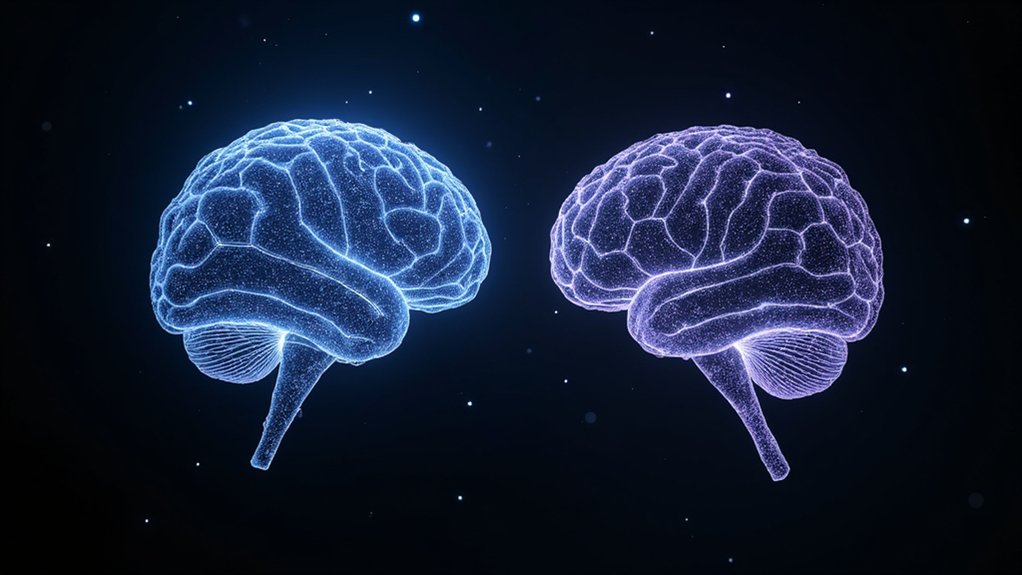
While tech companies boast about their latest AI marvels, the human brain still reigns supreme in the intelligence department. Let’s face it—the gap isn’t even close. Our brains pack roughly 86 billion neurons connected by a mind-boggling 100 trillion synapses. The biggest AI models? They top out at hundreds of billions of parameters. Do the math. That’s about 8,000 times less complex than what’s sitting between your ears right now.
Despite the AI hype, the human brain remains unmatched—86 billion neurons versus AI’s mere billions of parameters. The competition isn’t even close.
And talk about efficiency! A typical AI needs billions of words or images just to get smart. Kids? They learn language with 3,000 times less data. A child takes a few years to master thousands of words while experiencing life through all their senses. AI crunches similar data in hours but misses the whole “being alive” part. Kinda important, don’t you think?
Then there’s the power bill. Your brain runs on about 20 watts—roughly the equivalent of a dim light bulb. Meanwhile, training large AI models demands kilowatts, sometimes megawatts of electricity. The environmental impact is concerning, with energy consumption projected to exceed small countries by 2027. Not exactly environmentally friendly, these digital brainlets.
Sure, AI has its moments. It processes certain tasks at lightning speed. Some vision models perform impressively with fewer parameters than you’d expect. OpenAI’s Whisper handles speech-to-text with just 1.2 billion parameters, while our auditory cortex contains nearly a billion neurons. Even small animals like mice demonstrate remarkable general intelligence, showing that AGI exists in nature at scales much smaller than current AI systems.
But here’s the thing. Humans seamlessly integrate multiple senses, reasoning, and physical interaction. We handle abstract concepts. We feel emotions. We get creative. AI? It’s still stumbling around in narrowly defined spaces, following the paths we’ve carefully laid out.
The architecture is fundamentally different too. Our brains use both analog and digital signaling. They’re messy, varied, adaptive. AI is purely digital, more rigid, less diverse. However, healthcare systems are increasingly leveraging machine learning to identify patterns that predict health risks before human doctors might notice them.
References
- https://hosanagar.substack.com/p/gen-ai-models-vs-the-human-brain
- https://pmc.ncbi.nlm.nih.gov/articles/PMC11099251/
- https://www.beren.io/2022-08-06-The-scale-of-the-brain-vs-machine-learning/
- https://www.quantamagazine.org/ai-is-nothing-like-a-brain-and-thats-ok-20250430/
- https://halcrawford.substack.com/p/ai-versus-the-human-brain