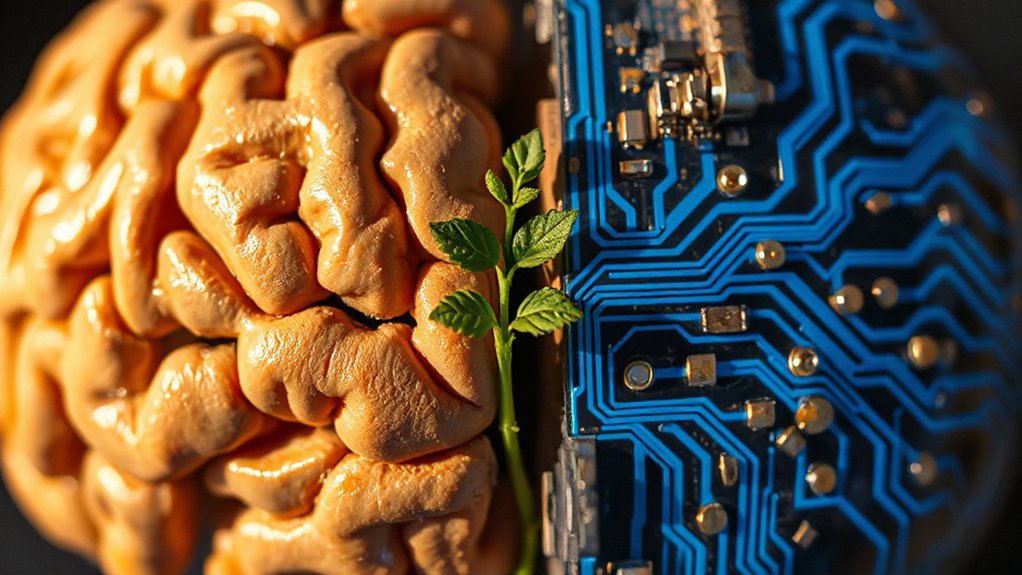
The scientific community faces a growing challenge as AI models outperform humans in prediction tasks. While AI excels at processing vast data and reducing decision “noise,” it lacks vital judgment capabilities involving ethics, values, and human preferences. AI trained on biased data can produce unfair outcomes and misses important contextual understanding. Experts suggest combining AI’s consistent insights with human ethical judgment creates the most effective approach. The future requires finding the right balance between technological efficiency and human wisdom.
As artificial intelligence continues to evolve, the line between machine prediction and human judgment grows increasingly complex. Modern AI systems like GPT-4 excel at prediction tasks, offering consistent answers where humans might vary widely. These systems can process vast amounts of data and identify patterns that humans might miss, making them valuable tools in many fields.
AI models have a key advantage over humans when it comes to reducing “noise” – the random variability that affects human decisions. When doctors, judges, or financial analysts make decisions, they don’t always reach the same conclusions with the same information. AI doesn’t have this problem, which makes its predictions more reliable in certain situations.
AI eliminates human decision noise, delivering consistent predictions where experts often vary—a crucial advantage in high-stakes fields.
However, machines face serious challenges when it comes to judgment. While AI can tell us what might happen, it can’t tell us what should happen. Judgment involves weighing values, ethics, and human preferences – areas where AI still falls short. These systems often struggle with abstract concepts like fairness or justice that are central to many important decisions. Recent studies show that AI trained on factual data rather than normative judgments tends to deviate significantly from human expectations. AI systems function fundamentally as prediction machines that can provide probabilities but cannot make personalized decisions without understanding individual preferences. Unlike machine learning systems that require large datasets to function effectively, human experts can often make sound judgments with limited information.
The risks of over-reliance on AI are significant. When trained on biased data, AI systems can produce unfair outcomes. Without proper human oversight, important ethical considerations might be ignored. AI lacks the contextual understanding that humans bring to complex situations.
Scientists and tech experts now suggest that the most effective approach combines AI predictions with human judgment. In this partnership, AI handles data analysis and pattern recognition, while humans provide the ethical framework and value judgments. This integration allows organizations to benefit from AI’s consistency while maintaining human input on subjective matters.
As AI technology advances, finding the right balance becomes increasingly important. Too much reliance on machines risks losing the human element in decision-making, while ignoring AI capabilities means missing out on valuable insights. The future likely belongs to those who can effectively combine the strengths of both AI predictions and human judgment.