While tech bros debate the latest AI chatbot, up to 757 million people face chronic hunger every single day. That’s not a typo. That’s roughly the population of Europe, starving, right now.
But here’s where things get interesting. Or depressing. Depends on your perspective.
AI isn’t just for writing bad poetry anymore. Turns out, machine learning can actually do something useful – like preventing mass starvation. In Somalia and Yemen, AI systems detect 80% of food emergencies before they hit. That’s right, computers are now better at predicting famines than humans. What a time to be alive.
Machine learning predicts famines better than humans – detecting 80% of food emergencies before impact.
The technology tracks real-time prices across 2,100 markets in 36 countries. It optimizes water usage for smallholder farmers who’ve never heard of ChatGPT. It streamlines supply chains so food doesn’t rot in warehouses while people starve ten miles away. Basic stuff, really. NotCo uses AI to reverse-engineer animal products, creating plant-based alternatives that actually taste like the real thing. Yet ironically, as these AI solutions develop, they contribute to the very climate crisis threatening food security through their massive energy consumption.
Here’s the kicker: AI makes all this happen at a fraction of traditional costs. The Global Food and Nutrition Security Dashboard crunches data from over 40 organizations. Statistical models flag critical risks. Machine learning breaks through the fragmented mess of global food data. It’s almost like having a competent system for once.
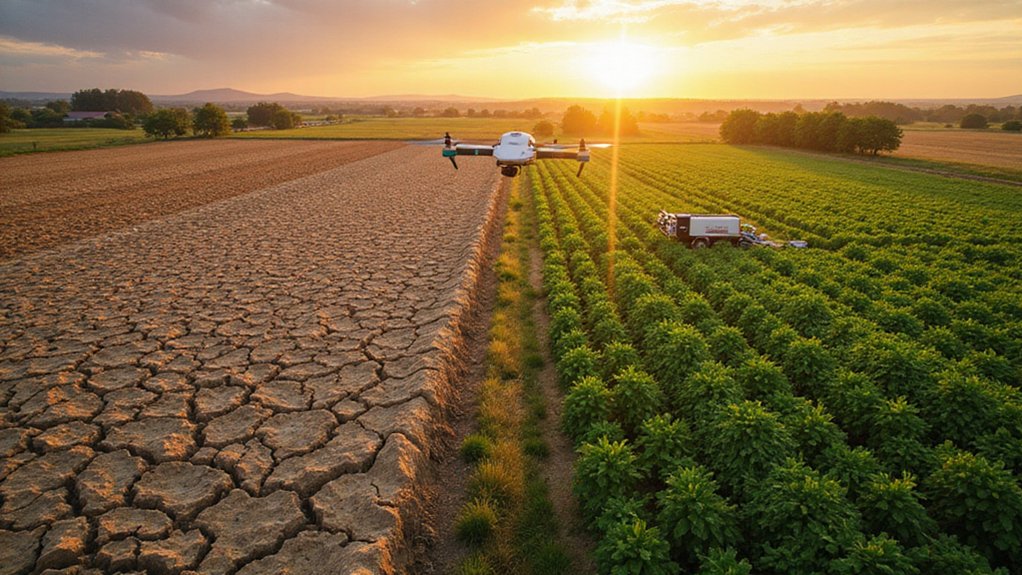
Precision agriculture helps farmers use exactly the right amount of fertilizer. Not too much, not too little. Goldilocks would be proud. AI-powered supply chains reduce transport costs and minimize waste. Plant-based food innovations get developed faster. Everything becomes more sustainable, more efficient, more resilient.
But let’s be real. Technology alone won’t save anyone. These solutions need quality data, local expertise, and responsible partnerships. Remote areas with sketchy internet aren’t exactly Silicon Valley. Implementation remains messy, complicated, and frustratingly human. AI tools like DEEP work without connectivity, performing crucial damage assessments even when telecommunications fail.
Still, the potential is staggering. AI could transform how we grow, distribute, and manage food globally. It could be the difference between chronic hunger and actual sustenance for hundreds of millions.
Will AI rescue humanity from the growing food crisis? Maybe. But it’ll take more than algorithms. It’ll take people actually giving a damn about using this technology where it matters most.
References
- https://www.news-medical.net/news/20250525/Can-AI-solve-tomorrowe28099s-global-food-crisis.aspx
- https://reliefweb.int/report/world/does-artificial-intelligence-hold-key-ending-hunger
- https://pos.toasttab.com/blog/on-the-line/ai-in-the-food-industry
- https://www.diplomaticourier.com/posts/can-ai-solve-hunger-the-promise-of-technology-in-food-security
- https://blogs.worldbank.org/en/opendata/five-alarming-statistics-on-global-hunger