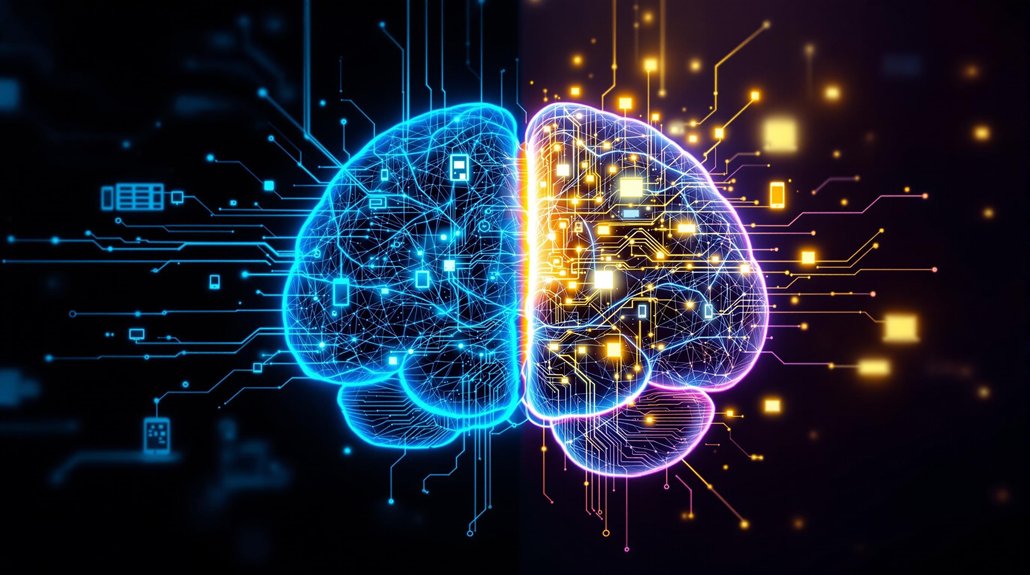
AI shows both promise and peril for human cognition. While it uncovers hidden brain patterns and enhances medical diagnostics, excessive reliance may cause cognitive decline. Researchers note the “Google Effect,” where people remember less information when they expect easy access to it later. Balancing AI use with independent thinking activities helps maintain brain health. Scientists are working to maximize benefits while protecting cognitive abilities as AI integration grows. The future balance may determine our mental landscape.
How exactly is artificial intelligence changing the human brain? Scientists are discovering that AI isn’t just changing our world—it’s changing how our minds work too. Recent studies show that AI tools are having both positive and negative effects on human cognition.
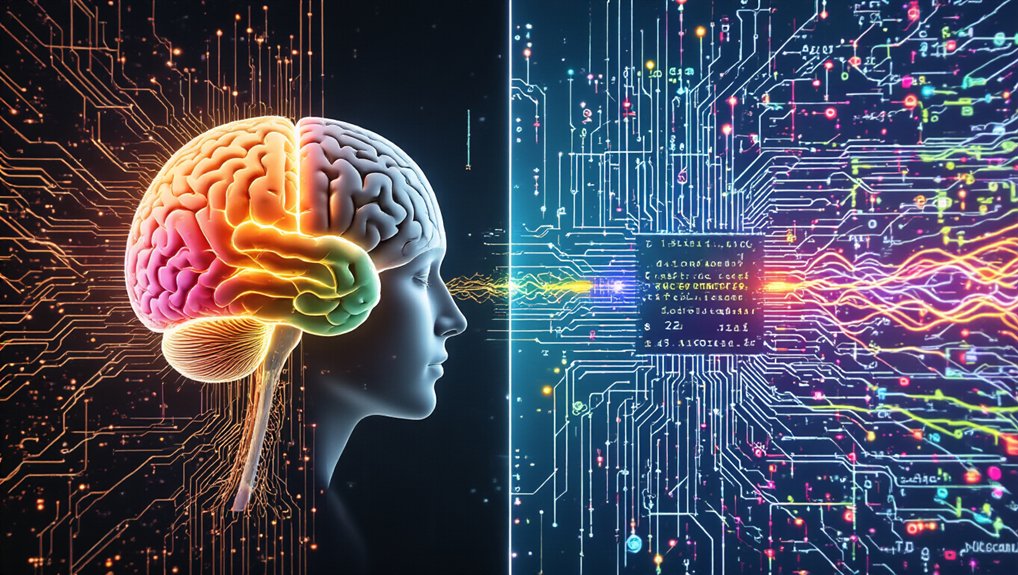
AI is helping scientists understand the brain in new ways. Advanced models like auto-encoders have revealed insights into spontaneous brain activities that traditional methods couldn’t detect. These discoveries are improving our knowledge of how the brain processes information, even when there’s no external input. A groundbreaking study by researchers at FAU demonstrated that the human brain continuously progresses through active states defined by local field potentials.
AI reveals hidden brain patterns, uncovering how our minds process information even during rest.
People using AI-powered tools can solve problems faster by accessing large data sets quickly. Educational technologies with AI features create personalized learning experiences that help users learn new skills more efficiently. These technologies are also advancing medical treatments through brain-computer interfaces that assist people with neurological disorders. Similar to healthcare applications, AI systems like Google DeepMind can identify eye diseases with remarkable accuracy, potentially saving vision through early detection.
However, researchers warn that relying too heavily on AI for everyday tasks may lead to cognitive atrophy—a weakening of mental abilities. This is similar to the “Google Effect,” where people remember less information because they know they can search for it later. The overreliance on AI for daily tasks previously done manually may diminish our independent thinking capabilities over time.
When AI handles thinking tasks for us, we might lose important mental skills over time. Scientists are particularly concerned about decreased neuroplasticity—the brain’s ability to form new connections—when people use AI instead of thinking through problems themselves. Critical abilities like decision-making and problem-solving could suffer from lack of regular practice.
To maintain brain health while using AI, experts suggest balancing technology use with activities that require independent thinking. They recommend designing AI systems that involve users in the decision process rather than simply providing answers.
As AI becomes more integrated into daily life, researchers, educators, and policymakers are working to understand how to maximize its benefits while protecting cognitive health. The goal is to use AI as a tool that enhances human thinking rather than replacing it.