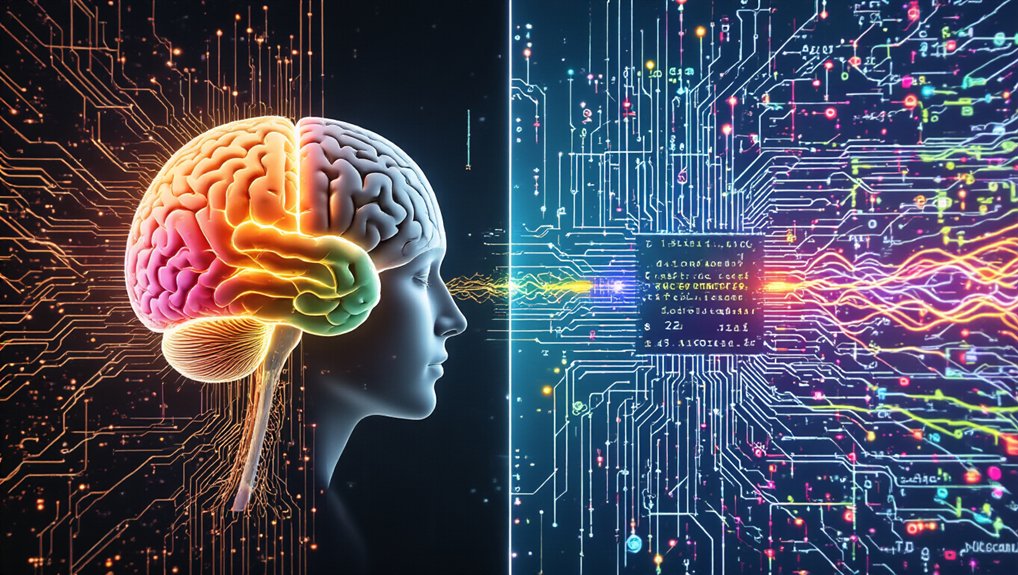
How close are we to machines that truly think like humans? Today’s AI systems are increasingly built on cognitive psychology principles, mimicking the way our brains learn and process information. Developers are programming algorithms that can reason, self-correct, and even simulate emotional understanding. Impressive, right? Or just smoke and mirrors?
Large language models like ChatGPT spew fluent, persuasive text that looks like human thought. They’re quick. They’re confident. They’re also completely faking it. The illusion is convincing—AI responds faster than humans ever could, giving us the impression of intelligence while masking its fundamental limitations.
Here’s the hard truth: AI lacks the emotional grounding that shapes human cognition. Machines don’t have lived experiences or personal histories. They don’t feel disappointment, joy, or embarrassment. No AI has ever had a bad day, fallen in love, or worried about its future. They respond without intention, without a continuous sense of self. These systems operate statelessly through probability, producing outputs without the context of previous interactions that humans naturally maintain.
AI simulates thought but cannot feel pain, love, or fear—it’s intelligence without the human experience that gives meaning.
Learning methods differ dramatically between humans and machines. Children learn through sensory-rich experiences and context. They touch, taste, and test. AI? It consumes massive datasets, finding patterns without understanding. Recent advancements now allow AI systems to process multiple input types simultaneously, including text, images, voice, and video. It’s like knowing the recipe without ever tasting the cake.
Common-sense reasoning remains a massive hurdle. Humans navigate ambiguity instinctively. We get confused, backtrack, and update our beliefs. AI doesn’t experience cognitive friction—that mental effort that leads to genuine creativity and problem-solving. It just calculates probabilities.
Researchers are trying to bridge these gaps, mimicking children’s learning processes to improve AI adaptability. Some progress is happening. UCLA researchers have found that AI can perform similar to college students on certain logic problems, yet the underlying mechanisms remain fundamentally different. But we’re nowhere close to machines with authentic understanding.
The danger lies in confusing fluency with comprehension. When ChatGPT confidently explains quantum physics, we mistake its pattern-matching for knowledge. It’s just sophisticated mimicry—a cognitive puppet show without the strings.
Truly human-like thinking requires more than psychology-trained algorithms. It demands something we haven’t figured out how to program: genuine experience.
References
- https://www.psychologytoday.com/us/blog/the-digital-self/202504/how-humans-think-and-ai-generates
- https://newsroom.ucla.edu/stories/ai-isnt-learning-like-us-can-it-think-like-us-faculty-research-lecture
- https://www.psychologicalscience.org/publications/observer/human-insights-machine-smarts.html
- https://www.psychologytoday.com/us/blog/the-digital-self/202506/ai-and-the-epistemology-of-the-synthetic-mind
- https://www.science.org/content/article/researchers-claim-their-ai-model-simulates-human-mind-others-are-skeptical