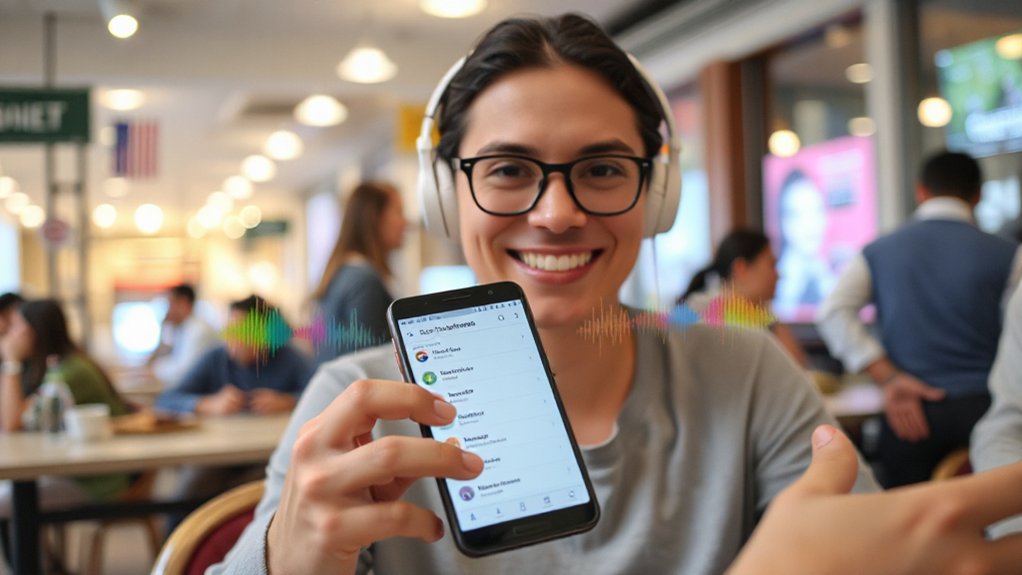

Google has announced a new beta feature that turns regular headphones into real-time translation devices. The feature was revealed on December 12, 2025, with initial rollout on Android in the United States, Mexico, and India. It works with any pair of headphones, not just Google’s Pixel Buds, making translation technology more accessible to everyone.
Google’s latest beta transforms ordinary headphones into translation tools, democratizing language technology for all users.
The new translation system operates through the Google Translate app under the “Live translate” section. Users simply open the app, tap on Live translate, and their phone captures incoming speech, translates it, and plays the translation through their connected headphones in real time.
What makes this system special is that it preserves the original speaker’s tone and emphasis, helping listeners better understand who is speaking. The technology maintains each speaker’s cadence for clarity when translating conversations.
At launch, the feature supports more than 70 languages. The technology combines on-device and cloud processing to balance speed, quality, and privacy. Google has integrated Gemini-class AI models to improve how the system handles idioms, slang, and context-dependent phrases.
This translation feature serves as a one-way translation experience, ideal for travelers listening to tour guides, students attending lectures in foreign languages, or workers in multilingual environments. The translations come directly to the user’s ears without disrupting the flow of conversation. According to Rose Yao, vice president of product and search at Google, this technology aims to break down language barriers in everyday situations.
Google plans to expand the feature to additional countries in 2026, with iOS support scheduled for the same year. While all headphones work with the system, those equipped with Google Assistant offer additional integration options.
The translation quality and response time may vary depending on the user’s device, operating system, and network connection. Some language features require an online connection for processing.
Google expects to refine the system’s speed and accuracy throughout the beta phase as more people use it and provide feedback. The company continues to make real-time translation more natural and accessible for everyday situations.
References
- https://techcrunch.com/2025/12/12/google-translate-now-lets-you-hear-real-time-translations-in-your-headphones/
- https://www.youtube.com/watch?v=Myb5Eryo2B0
- http://www.china.org.cn/world/Off_the_Wire/2025-12/13/content_118225969.shtml
- https://www.pocket-lint.com/headphones/news/google/146045-how-real-time-translation-works-on-google-assistant-headphones/
- https://store.google.com/intl/en/ideas/articles/pixel-live-translate/
- https://www.bet.com/article/csbk5o/see-the-google-headphones-that-can-translate-40-languages
- https://audiochamps.com/can-you-use-google-translate-with-headphones/