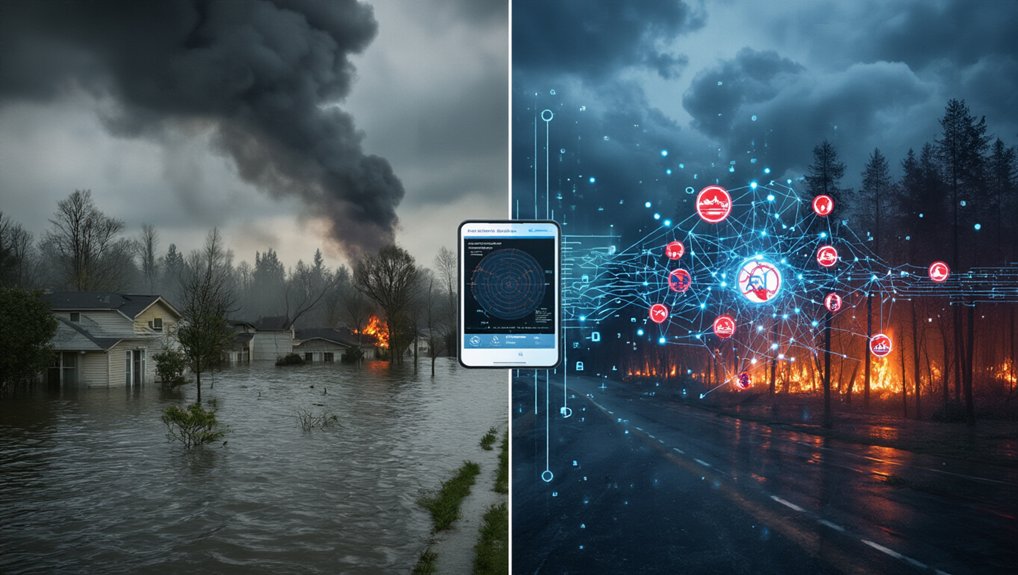

While floods rage and fires burn, misinformation spreads just as fast—maybe faster. A viral post claiming “toxic chemicals” in floodwaters can trigger panic. Unfounded evacuation rumors during wildfires? People die.
Disasters come in pairs: the natural kind and the information crisis that follows. Both kill.
But there’s good news in the battle against bogus disaster intel: artificial intelligence is stepping up big time. Transformer-based models like BERT and GPT are crushing traditional algorithms at sniffing out lies. They’re not just marginally better—they dominate in accuracy, precision, recall, and F1-score metrics.
These fancy AI systems capture nuances in language that older tech simply missed. False positive rates? Way down, thanks to attention mechanisms that analyze context from both directions.
Real-time monitoring is the game-changer here. Modern systems flag suspicious content in under two seconds. Two seconds! That’s barely enough time to finish reading a tweet. When some viral nonsense claims the hurricane is “government-controlled weather manipulation”—AI catches it before it reaches thousands.
The tech doesn’t just spot individual falsehoods. It maps entire narrative arcs and coordinated campaigns. The distinction between misinformation and disinformation is crucial, as one spreads unintentionally while the other involves deliberate deception. See five suspiciously similar posts about “secret evacuations” popping up simultaneously? AI notices that pattern instantly. Bots pushing disaster scams? Flagged.
NLP tools are analyzing sentiment too, detecting weird spikes in negative posts that often signal misinformation attacks. They categorize content by emotional tone and urgency, helping emergency managers prioritize which fires to put out first (metaphorically speaking, of course).
All this tech wizardry serves a significant purpose: building public trust. When officials can quickly counter rumors with facts, communities stay safer. People actually follow evacuation orders. They don’t drink bleach to “purify” water because someone on Facebook said so.
Successful chatbots like the CDC’s “CoronaBot” and Red Cross’s Clara have demonstrated how AI-powered conversational tools can effectively counter misinformation in real emergency situations.
With AI models now achieving 86% accuracy on complex reasoning tests, their ability to discern fact from fiction during disasters has never been more powerful.
Is AI perfect? Nope. Human oversight remains essential. But the days of misinformation running unchecked through disaster zones are numbered. When seconds count, algorithms that never sleep might just save lives.
References
- https://journals.sagepub.com/doi/10.1177/27523543251325902
- https://insideclimatenews.org/news/09072025/ai-could-limit-natural-disaster-misinformation/
- https://pure.iiasa.ac.at/id/eprint/20429/
- https://news.fiu.edu/2025/weaponized-storytelling-how-ai-is-helping-researchers-sniff-out-disinformation-campaigns
- https://bush.tamu.edu/wp-content/uploads/2025/06/Davis_Final-Report_Inquiry-into-AI-as-related-to-Emerg-Mgmt_24-25.pdf