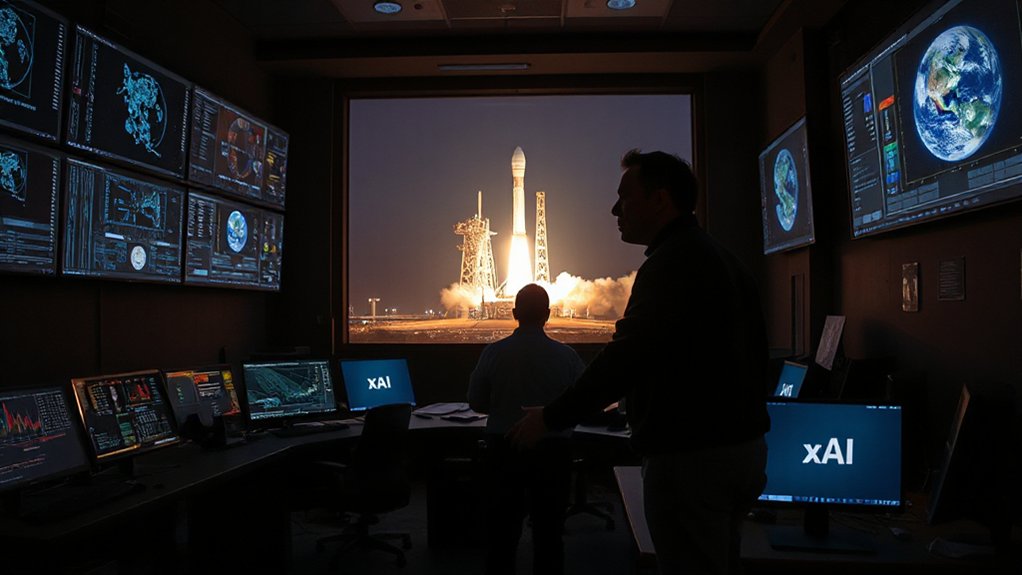
Elon Musk shocked the business world on Monday when SpaceX officially acquired xAI in a record-breaking deal that values the combined company at $1.25 trillion. The merger, announced on February 2, 2026, brings together SpaceX’s rocket and satellite technology with xAI’s artificial intelligence capabilities.
The deal represents the largest merger in global history. Before joining forces, SpaceX was valued at roughly $1 trillion while xAI was worth between $230-250 billion. Together, they’ve created what Musk describes as “the most ambitious, vertically-integrated innovation engine on (and off) Earth.”
At the heart of this merger is an ambitious plan to build orbital data centers. The company plans to launch up to one million AI satellites powered by solar energy in space. Musk believes that “within 2 to 3 years, the lowest cost way to generate AI compute will be in space.”
The merger addresses a growing concern that Earth won’t have enough electricity or cooling capacity to meet the rising demand for AI computing. The newly merged company hopes to overcome the environmental impact associated with traditional AI training methods, which consume massive amounts of electricity and produce significant carbon emissions. Space-based systems can access continuous solar energy without terrestrial power constraints. SpaceX has already filed with the FCC for permission to launch this satellite constellation.
The financial structure makes sense for both companies. While xAI currently spends about $1 billion monthly, SpaceX earns up to 80% of its revenue from launching Starlink satellites. The merger guarantees steady revenue through continuous satellite launches, especially since regulations require satellites to be replaced every five years.
The combined company is preparing for an IPO as early as June 2026, potentially valuing it at more than $1.5 trillion. Wall Street rumors suggest the IPO could raise as much as $50 billion. This timeline may be influenced by SpaceX’s current focus on proving Starship’s capability for future lunar and Martian missions.
This merger consolidates three major Musk-owned entities: SpaceX, xAI, and the X platform (formerly Twitter). Two merger scenarios were considered before the final decision to combine SpaceX with xAI, leaving Tesla as a separate entity.
Tesla, despite investing $2 billion in xAI earlier this year, remains separate from this new corporate structure.
The combined company now faces the challenge of executing this unprecedented vision of space-based AI computing infrastructure.
References
- https://techcrunch.com/2026/02/02/elon-musk-spacex-acquires-xai-data-centers-space-merger/
- https://techcrunch.com/2026/01/29/elon-musk-spacex-tesla-xai-merger-talks-ipo-reuters/
- https://electrek.co/2026/02/02/spacex-bails-out-xai-in-mega-deal-heres-what-it-means-for-tesla/
- https://www.youtube.com/watch?v=FfjURAGN70A
- https://www.foxbusiness.com/fox-news-science/spacex-acquires-xai-record-setting-deal-valued-over-1t