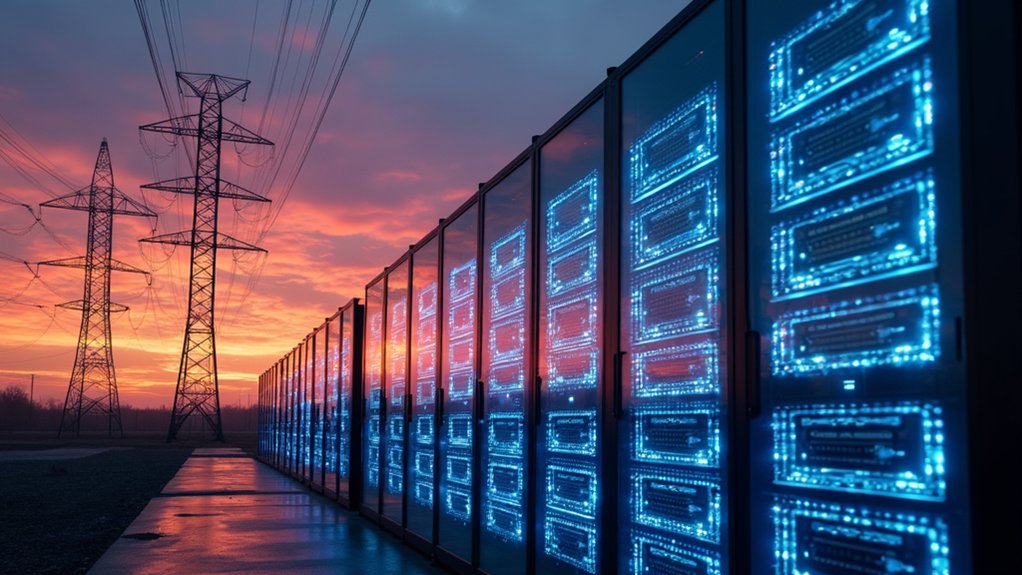

While artificial intelligence transforms many industries, it’s also creating an unexpected problem for America’s power grid. Data centers powering AI systems are using enormous amounts of electricity, with projections showing they could increase global power demand by 50% by 2027. According to Goldman Sachs Research, this demand might rise by as much as 165% by the end of the decade.
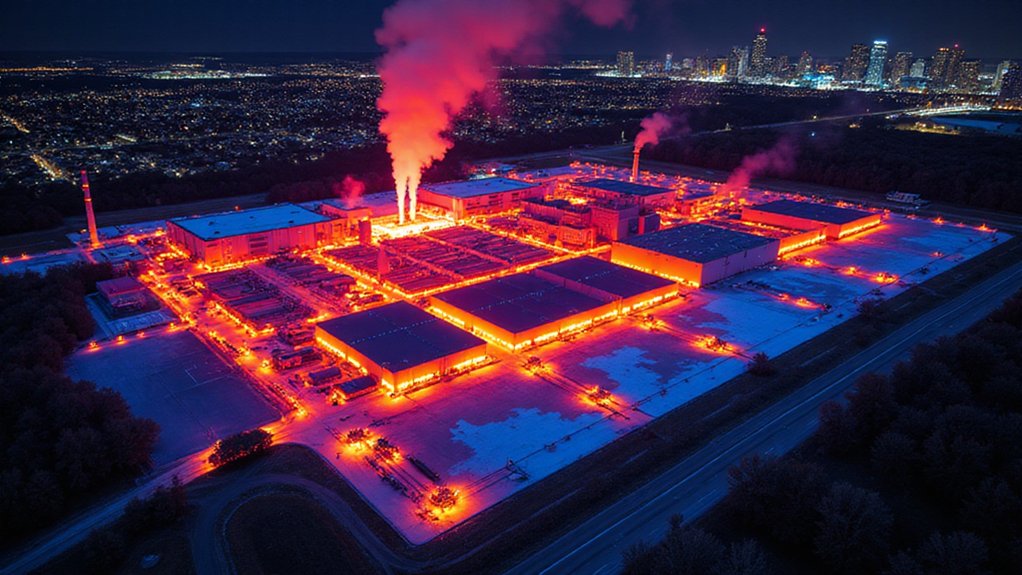
These AI facilities aren’t just consuming power—they’re disrupting it. The centers cause what experts call “bad harmonics” in the power supply. This means the normally smooth wave pattern of electricity becomes jagged with spikes and dips. Over three-quarters of these distorted power readings in the U.S. appear within 50 miles of large data centers.
AI data centers don’t just consume electricity—they warp it, creating jagged power patterns that ripple outward for miles.
The problem is especially bad near major AI hubs like Chicago and Northern Virginia’s “data center alley.” Approximately one million residential sensors now track these power issues across the country. The data shows a clear pattern—the closer homes are to data centers, the worse their power quality becomes.
For everyday Americans, these power problems can damage household appliances. Refrigerator motors might rattle from irregular electricity. More seriously, power surges can cause overheating, malfunctions, and even home fires in some cases. These issues could potentially lead to billions in damages to consumer electronics and electrical infrastructure nationwide.
The core issue is that America’s power grid wasn’t built for AI’s unique energy needs. Current infrastructure is struggling to handle the concentrated demand from these computing clusters. The roughly 2,700 data centers operating across the United States are pushing our aging grid to its limits. AI already accounts for a significant portion of electricity consumption that’s expected to more than double to 9% by 2030. A single AI interaction with services like ChatGPT consumes nearly ten times the electricity of a standard Google search.
Companies like Whisker Labs are using home sensors to monitor these issues, revealing the extent of the problem. These harmonics serve as an early warning sign of deeper stress in our grid infrastructure.
As AI continues its rapid growth across various sectors, the question remains whether our aging power systems can keep up with the digital transformation‘s voracious appetite for electricity.
References
- https://www.cbsnews.com/news/how-surging-demand-for-energy-and-rise-of-ai-is-straining-the-power-grid-in-u-s/
- https://carboncredits.com/ais-energy-hunger-is-straining-americas-power-grids-and-your-home-appliances/
- https://www.goldmansachs.com/insights/articles/ai-to-drive-165-increase-in-data-center-power-demand-by-2030
- https://earth.org/generative-ai-is-exhausting-the-power-grid/
- https://www.datacenterdynamics.com/en/news/ai-data-centers-causing-distortions-in-us-power-grid-bloomberg/