
When a Bedouin shepherd stumbled into a cave near the Dead Sea in 1947, he wasn’t looking for ancient manuscripts—he was chasing a stray goat. What he found instead would shake up the academic world for decades. The Dead Sea Scrolls, as they came to be known, turned out to be way older than anyone initially thought.
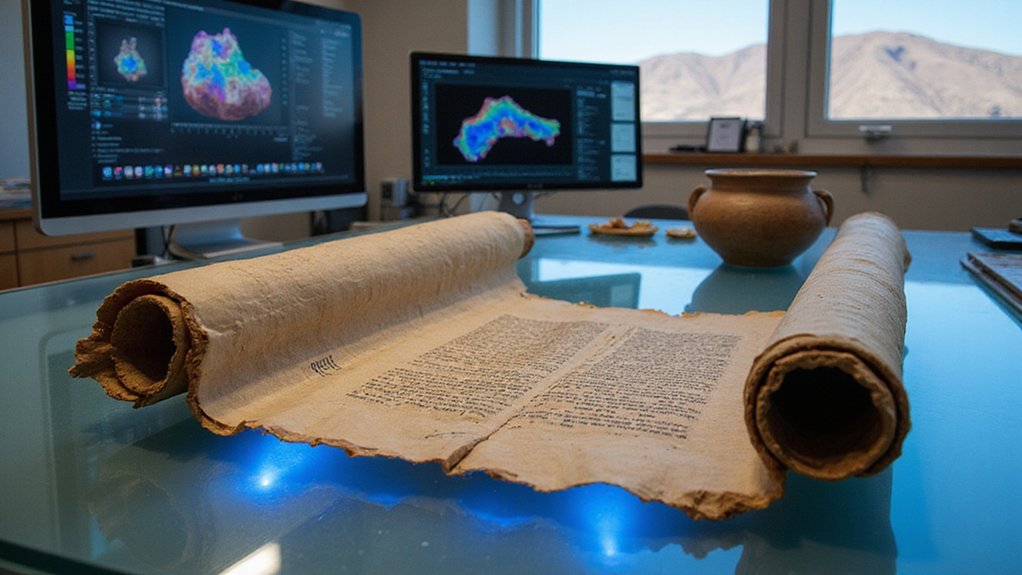
Recent AI technology is now revealing these texts date back to the 3rd century BCE. That’s ancient. We’re talking about documents that predate Christ by centuries. The tech nerds running algorithms on these fragments keep pushing the dates further back, making biblical scholars sweat over their previous assumptions. Among the most significant finds, MUR 17 has been identified as the earliest manuscript in the collection.
The scrolls themselves are a mixed bag—biblical texts, sectarian documents, legal writings, the works. Most are in Hebrew, some in Aramaic and Greek. But here’s the kicker: these aren’t just any old religious texts. They’re the earliest surviving copies of Old scriptures, pushing back our knowledge of Hebrew biblical manuscripts by over 1,000 years. That’s not a typo. The initial batch included seven scrolls found by the shepherd, with four scrolls being sold to Archbishop Samuel for about $250 in April 1947.
These aren’t just any old religious texts—they’re the earliest surviving copies of Old scriptures.
Between 1947 and 1956, eleven caves around Qumran coughed up fragments from about 800 to 900 manuscripts. The Essenes, a Jewish sect that probably lived at Qumran from around 100 to 68 BCE, apparently had a thing for hiding their library in jars. Smart move, considering the Romans were coming to trash the place during the Judean revolts.
The dry desert air did what no museum could—preserved these texts for two millennia. Now, over 15,000 fragments sit in places like the Israel Museum in Jerusalem, where researchers armed with infrared imaging and AI continue to piece together the puzzle.
These discoveries didn’t just tweak our understanding of ancient Judaism—they rewrote it. The scrolls revealed how Jewish law developed, what people expected from their messiah, and how biblical texts changed over time. They even shed light on early Christianity’s origins, though some scholars probably wish they hadn’t.
Every new technological advance seems to reveal something that makes experts go back to their drawing boards. Turns out, ancient history is full of surprises.
References
- https://www.deadseascrolls.org.il/learn-about-the-scrolls/historical-timeline?locale=en_US
- https://www.imj.org.il/en/wings/shrine-book/dead-sea-scrolls
- http://www.gnosis.org/library/dss/dss_timeline.htm
- https://www.britannica.com/topic/Dead-Sea-Scrolls
- https://www.jewishvirtuallibrary.org/history-and-overview-of-the-dead-sea-scrolls