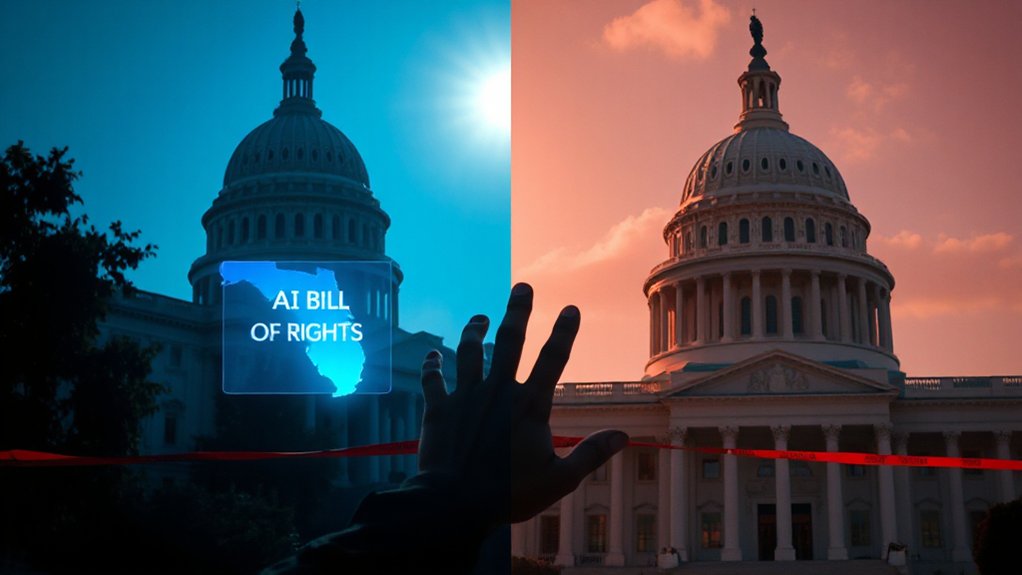

James Wilson, a Kentucky State University student, created the DOGE Initiative, an AI program that analyzes government regulations. The system quickly reviews thousands of pages of federal rules, finding outdated or contradictory regulations across agencies. It also generates plain-language summaries for better understanding. Wilson’s project aims to demonstrate how AI can responsibly improve government efficiency. This student-led innovation coincides with broader federal efforts on AI education and governance.
While the U.S. government continues to develop its approach to AI regulation, a resourceful college student has found a way to navigate the complex world of federal rules using artificial intelligence tools.
Twenty-year-old James Wilson, a computer science major at Kentucky State University, created a program that analyzes thousands of pages of government regulations in minutes. His project, dubbed the Digital Optimization for Government Efficiency (DOGE) Initiative, comes at a time when federal guidelines on AI remain limited.
“I wanted to show how AI could actually help us understand government better,” Wilson explained. As of April 2025, the American federal government has not enacted specific laws limiting AI use, despite growing concerns about its impact on employment and education.
Wilson’s program identifies outdated or contradictory regulations across different federal agencies. It then generates plain-language summaries that anyone can understand. The timing coincides with President Biden’s recent Executive Order titled “Advancing Artificial Intelligence Education for American Youth,” signed on April 23, 2025.
Wilson’s AI solution navigates the regulatory maze, delivering clarity just as the Biden administration prioritizes AI education for America’s youth.
The White House Task Force on Artificial Intelligence Education, established by this order, aims to guide implementation of AI education nationwide. The increase in initiatives reflects the fact that 94% of data leaders are now prioritizing data management practices as AI adoption accelerates. The Presidential Artificial Intelligence Challenge will launch by late July, promoting student innovation in AI.
Meanwhile, many KSU students have voiced concerns about the lack of federal regulation regarding AI. Some worry about jobs being replaced, particularly in healthcare assistance, marketing, administration, retail, and transportation sectors.
The U.S. Department of Education currently provides guidance on AI innovation and risk management, maintaining an inventory of AI use-cases in education. The Department of Labor is involved in AI initiatives to expand workforce development. The Department of Labor is also working to increase participation in AI-related registered apprenticeships across various industries.
Wilson believes his DOGE Initiative demonstrates responsible AI use. “We’re showing how AI can make government more accessible to everyone, not just experts,” he said.
As the federal government continues developing its approach to AI regulation through public-private partnerships and interdisciplinary collaboration, Wilson’s project highlights how students themselves are finding practical applications for these emerging technologies.
His work resembles efforts in Texas where lawmakers proposed the Texas Responsible AI Governance Act, which includes a regulatory sandbox for testing AI applications in controlled environments.
References
- https://www.whitehouse.gov/presidential-actions/2025/04/advancing-artificial-intelligence-education-for-american-youth/
- https://www.hklaw.com/en/insights/publications/2025/04/executive-order-advancing-ai-education-for-american-youth
- https://www.ncsl.org/technology-and-communication/artificial-intelligence-2025-legislation
- https://theksusentinel.com/2025/04/13/unregulated-ai-threatens-american-education-and-employment/
- https://www.ed.gov/about/ed-overview/artificial-intelligence-ai-guidance