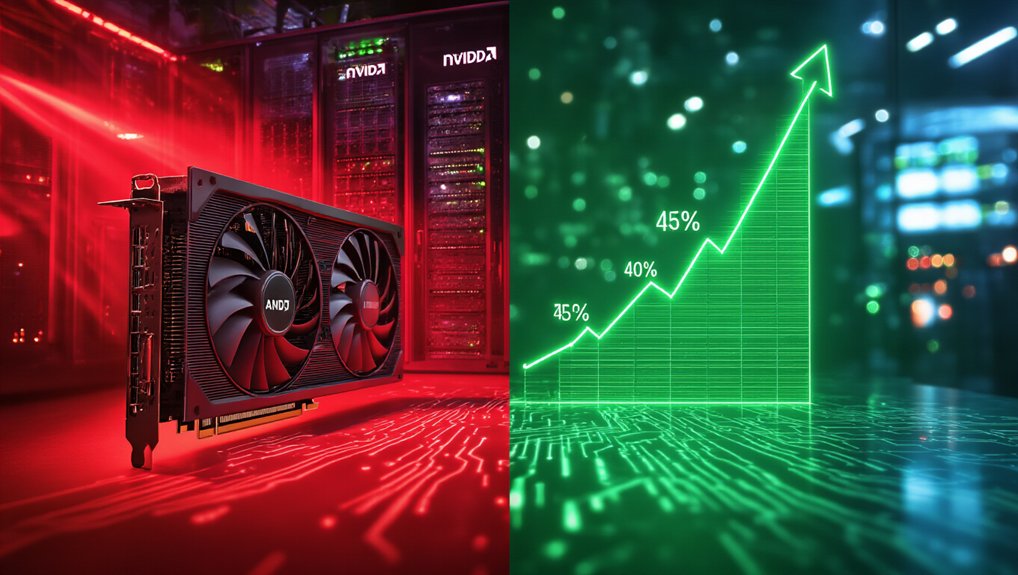

Surging into AI’s battleground, AMD is finally making Nvidia sweat. With a stunning 39.4% server CPU market share in 2025, AMD has dethroned Intel in servers while quietly chipping away at Nvidia’s GPU dominance.
Sure, their 11% share in data-center AI GPUs looks puny next to Nvidia’s 80-90% stranglehold, but that’s exactly how underdogs operate – they start small.
Don’t underestimate the 11%. Underdogs always start small before they bite.
The numbers don’t lie. AMD’s AI revenue is projected to jump from $5.5 billion in 2024 to over $7 billion in 2025. That’s not chump change. Investors noticed too, driving AMD’s stock up nearly 60% since April 2025. Not bad for the perennial second-place finisher.
AMD’s MI400 GPU packs 1.5 teraflops of processing muscle, taking direct aim at large-scale AI training workloads. Translation: They’re hunting in Nvidia’s territory now.
The upcoming MI355X GPU, slated for late 2025, could reverse AMD’s early-year market share dip following Nvidia’s Blackwell launch. Classic comeback story in the making.
Let’s be real though. Nvidia’s CUDA software ecosystem is still the 800-pound gorilla in the room. Their deep partnerships with AWS and Azure? Rock solid.
AMD’s Xilinx-based software stack is improving but playing catch-up. Lisa Su’s visionary leadership since 2014 turned the company from near bankruptcy risks into a formidable AI contender. Software ecosystems are stubborn beasts.
AMD’s strategy? Hit ’em where it hurts – the wallet. Their price-performance ratio makes budget-conscious enterprises take notice. This approach aligns perfectly with the 70% of businesses that are now reporting returns on their generative AI investments.
The MI400 GPU threatens Nvidia’s cushy margins with a competitive, cost-effective alternative. Brutal efficiency.
AMD’s MI300 GPU dominates H100 with its impressive 1,536GB HBM capacity, giving it a memory advantage that appeals to enterprises running memory-intensive AI workloads.
China’s proving to be fertile ground, with AMD’s GPU market share climbing 5% there in 2025. Thank easing trade tensions for that win.
Their diversified global approach spreads risk while building multiple revenue streams.
The semiconductor rivalry of the decade is heating up. AMD’s projected 23% revenue growth in 2025 and 19% in 2026 shows momentum.
David has loaded his slingshot. Goliath is watching.
References
- https://io-fund.com/artificial-intelligence/amd-vs-nvidia-stock-prediction-2028
- https://semianalysis.com/2025/05/23/amd-vs-nvidia-inference-benchmark-who-wins-performance-cost-per-million-tokens/
- https://www.ainvest.com/news/unlocking-ai-potential-amd-nvidia-valuation-edge-2025-tech-landscape-2506/
- https://www.nasdaq.com/articles/nvda-vs-amd-which-semiconductor-stock-smarter-ai-play-2025
- https://www.ebc.com/forex/amd-stock-forecast—can-it-exceed-nvidia