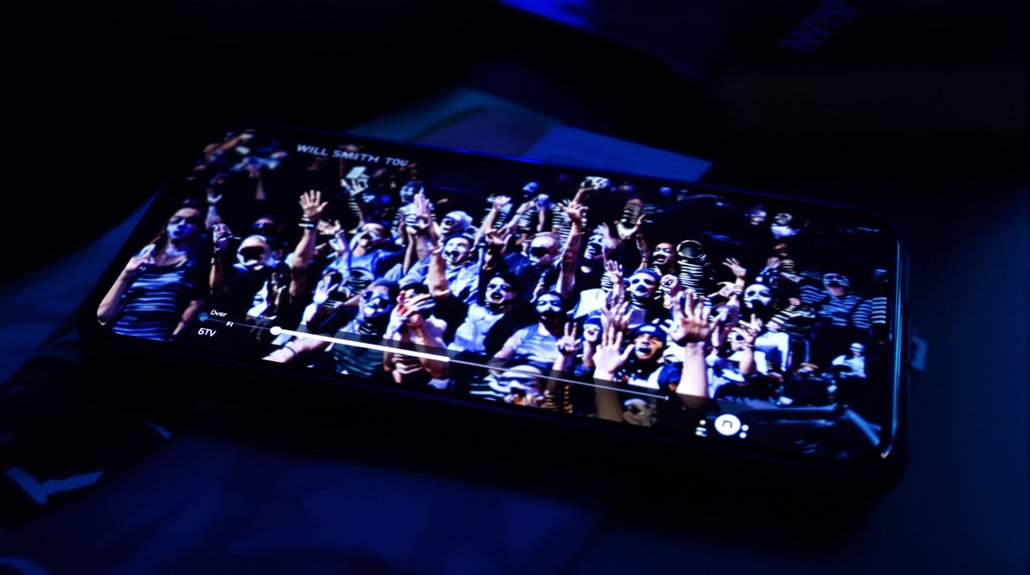

When Will Smith released a promotional video from his recent European tour, fans quickly spotted something disturbing in the crowd footage. The audience members had melting faces, six-fingered hands, and smeared limbs. Some fan signs in the video showed garbled, nonsensical text, though the original signs included messages like “From West Philly to West Swizzy” and personal thank-you notes. These visual glitches appeared in both the YouTube and Facebook versions of the video.
Disturbing AI glitches turned Will Smith’s concert footage into a nightmare of melting faces and six-fingered hands.
The strange images weren’t from a horror movie. They were the result of AI technology gone wrong. Smith’s team had used AI image-to-video software to enhance real photos from his European concerts. The technology created artificial effects that made genuine audience members look distorted. YouTube’s processing made the problems even worse, adding more visual artifacts to the montage clips.
Fans didn’t hold back their criticism on social media. They called the footage “embarrassing,” “low quality,” and “tragic.” Many questioned whether Smith’s fanbase was real or if his tour was actually successful. The backlash brought more negative attention to the rapper’s public image at a time when he was trying to make a comeback.
Major news outlets picked up the story quickly. NBC, Rolling Stone, VIBE, NME, The Daily Mail, The Independent, and Mashable all reported on the controversy. Media experts called it a “self-inflicted PR nightmare” for Smith. They warned about the risks artists face when using AI manipulation in their promotional materials.
The incident comes at a time when AI’s role in music is already controversial. A recent study predicts musician income will drop 20% by 2029 because of AI technology. Deezer reports that about 10,000 AI-generated tracks are uploaded daily to music platforms. The AI music industry is expected to generate €4 billion in revenue by 2025. Artists including Nick Cave and Paul McCartney are now advocating for changes in copyright laws to protect creative work.
The technical problems in Smith’s video were clear. AI upscaling and post-processing introduced the extra fingers and melted faces. The lack of quality control in the AI workflow led to these uncanny results. The final montage failed to maintain visual consistency.
This controversy highlights growing concerns about digital fakery in entertainment. It shows how difficult it’s becoming to tell real footage from AI-altered content.
References
- https://www.womg.com/2025/08/25/will-smiths-new-hype-video-features-ai-crowds/
- https://www.euronews.com/culture/2025/08/25/the-fresh-prince-of-bel-air-will-smith-accused-of-using-ai-for-embarrassing-tour-video
- https://waxy.org/2025/08/will-smiths-concert-crowds-were-real-but-ai-is-blurring-the-lines/
- https://www.youtube.com/watch?v=190oYhI9fMs
- https://fortune.com/2025/08/27/will-smith-ai-crowds-rap-comeback-public-image-nightmare/