
Every medical breakthrough starts with someone crazy enough to try. In Saudi Arabia, surgeons just pulled off something wild: they transplanted a human heart using robots. No massive chest-cracking surgery. Just tiny holes and mechanical arms doing the heavy lifting.
The team at King Faisal Specialist Hospital in Riyadh spent months practicing on dead bodies before attempting this insanity on a living person. Traditional heart transplants require sawing through the breastbone—it’s brutal, painful, and leaves patients wrecked for weeks. These surgeons figured there had to be a better way.
Their guinea pig was a 16-year-old whose heart was basically giving up. The kid had end-stage heart failure from nonischemic dilated cardiomyopathy. Translation: his heart muscle was stretched out like old underwear and couldn’t pump blood worth a damn.
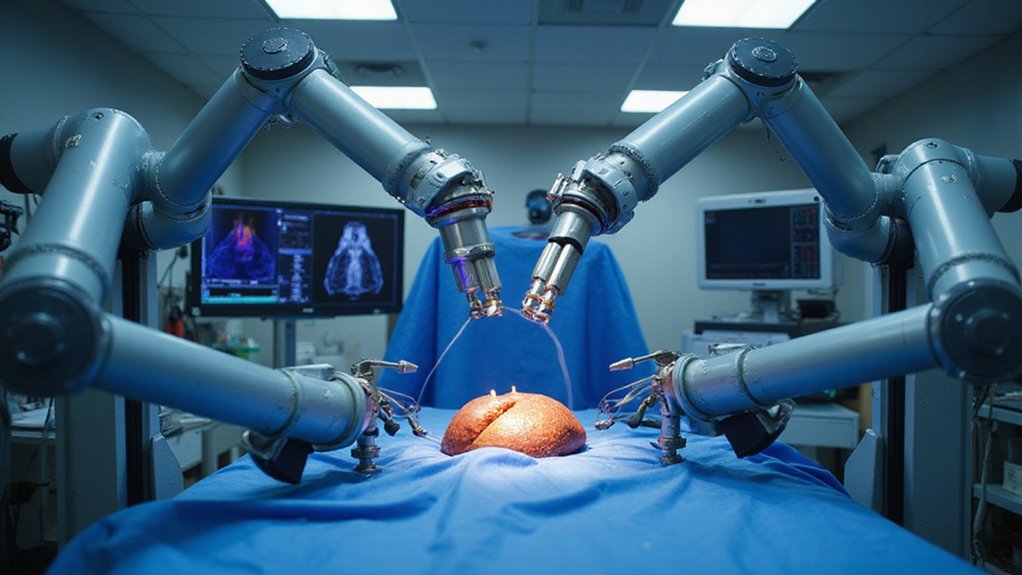
Instead of cracking his chest open like a lobster, they made four tiny 8mm holes and one 2cm incision in his right chest. Robot arms slipped through these ports while the surgeon sat at a console, manipulating everything remotely. They pumped CO₂ into the chest cavity to create working space—like inflating a balloon inside the ribcage.
Four tiny holes replaced chest-cracking brutality. Robot arms threading through ports while surgeons played video games with someone’s life.
The 3D imaging system gave them superhero vision. Every cut, every stitch, every movement was precise. The donor heart’s ischemic time—how long it sits without blood flow—stayed short. That’s vital. Dead heart tissue doesn’t come back to life, no matter how fancy your robots are.
The results? The kid was off the ventilator in less than 24 hours. He was walking around while traditional transplant patients would still be drugged up and immobilized. Less pain, faster recovery, home sooner. The surgeons used a three-coordinate approach similar to robotic cardiac techniques, ensuring precise port placement for optimal access to the heart.
But here’s the catch: this isn’t happening at your local hospital anytime soon. The learning curve is steep. You need elite surgeons, million-dollar robots, and nerves of steel. Most cardiac teams will stick with the old chest-cracking method that’s worked for decades. Despite the challenges, this technique eliminates the need for sternotomy recovery that typically keeps patients hospitalized for weeks after traditional open-heart procedures.
Still, someone had to be first. Someone always has to be crazy enough to try.
References
- https://www.annalscts.com/article/view/17140/html
- https://www.hopkinsmedicine.org/health/treatment-tests-and-therapies/robotic-cardiac-surgery
- https://columbiasurgery.org/conditions-and-treatments/guide-robotic-heart-surgery-what-expect
- https://pubmed.ncbi.nlm.nih.gov/40015612/
- https://my.clevelandclinic.org/health/procedures/22173-total-artificial-heart