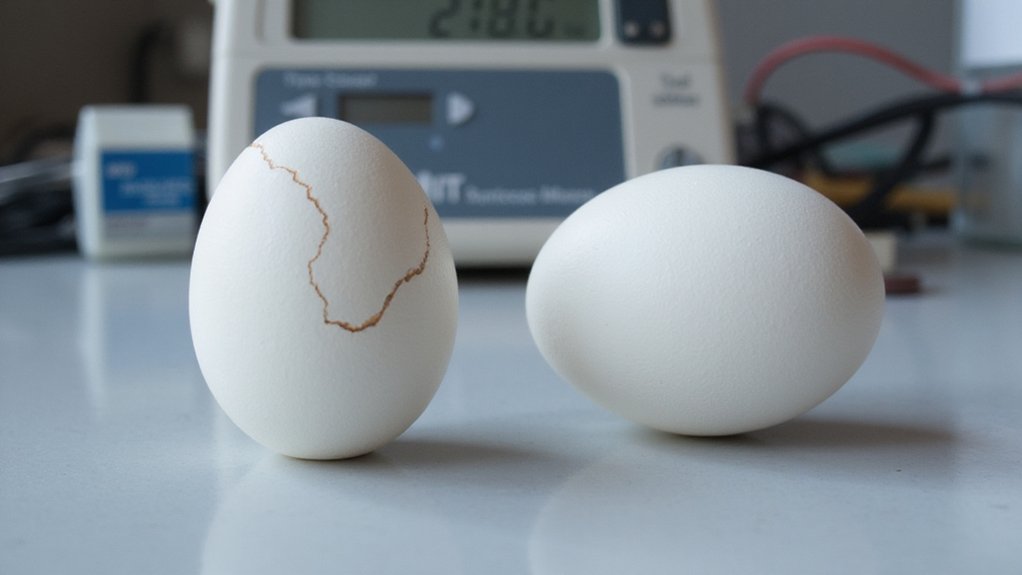

MIT researchers have turned egg wisdom upside down—or rather, sideways. Their study reveals that eggs break less when placed horizontally instead of vertically during falls. Tests showed less than 10% of sideways eggs cracked from certain heights, while over half of vertical eggs shattered. This discovery challenges what people have believed for generations. The findings could change how egg producers package and ship their products. What other common beliefs about everyday objects might science overturn next?
Conventional wisdom has been cracked wide open by MIT engineers who discovered that eggs are actually stronger when positioned sideways. In a surprising study published in Communications Physics in May 2025, researchers conducted 180 drop tests that directly contradicted what many science teachers have taught for years.
The MIT team tested eggs dropped from heights of 8, 9, and 10 millimeters onto hard surfaces. They used 60 eggs for each test height and carefully controlled the orientation. The results were clear – eggs placed horizontally survived falls much better than vertical ones.
From an 8mm drop, less than 10% of horizontally-positioned eggs broke. In contrast, more than 50% of vertically-positioned eggs cracked from the same height. The scientists also found that whether the pointed end faced up or down made no difference in breakage rates.
To explain this unexpected finding, researchers performed compression tests on 60 additional eggs. They discovered both orientations require the same amount of force (45 newtons) to break. The key difference is that horizontal eggs can compress further before reaching their breaking point.
“Eggs are more flexible around their equator, allowing them to absorb energy better when falling sideways,” explained one researcher. The study showed that eggs might be stiffer when standing up, but they’re not tougher in that position.
This discovery has real-world implications for the egg industry. It could change how eggs are packaged and transported, potentially reducing breakage during shipping. The findings also impact education, especially for the popular “egg drop challenge” in science classrooms.
The MIT study shows the importance of testing common beliefs scientifically. What seemed like an established fact has been proven false through careful experimentation. The research team meticulously recorded breakage outcomes throughout their testing to ensure scientific validity.
The researchers now suggest their findings could apply to other engineering problems and packaging designs beyond just eggs, demonstrating how questioning accepted “facts” can lead to valuable new insights. The research was led by Tal Cohen and published with DOI number 10.1038/s42005-025-02087-0.