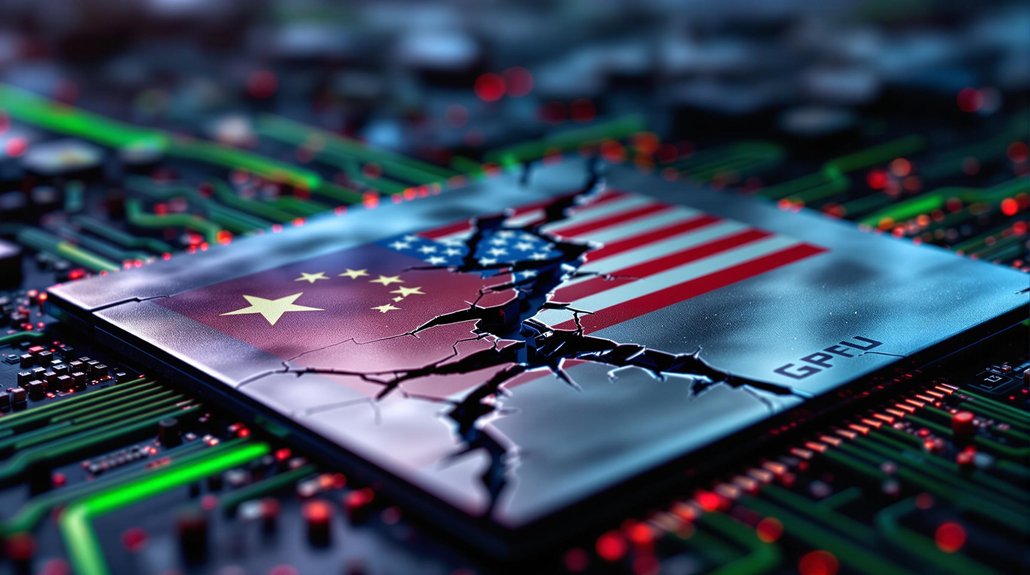
Nvidia’s position as AI’s chip powerhouse faces unprecedented pressure from the U.S.-China trade war. The company can’t sell to a market that once brought in 13% of its revenue. Stock prices have dropped as investors worry about future growth. Supply chains are disrupted by tariffs and trade restrictions. Regulatory hurdles in China add more complications. The question now: can this tech giant maintain its dominance when caught between two economic superpowers?
As tensions in the ongoing trade war between the U.S. and China continue to escalate, tech giant Nvidia finds itself caught in the crossfire. The company, which generates about 13% of its revenue from China, is facing significant challenges as U.S. export restrictions limit its ability to sell high-performance chips to Chinese clients. This restriction is already hurting Nvidia’s market reach in one of the world’s largest tech economies.
The impact is becoming visible in Nvidia’s financial performance. The company’s stock has experienced a sharp decline in recent months, partly due to these trade tensions. With a high beta of 2.4, Nvidia’s shares are particularly sensitive to market fluctuations, making them vulnerable during this period of economic uncertainty.
Making matters worse, China has implemented new environmental and efficiency rules that threaten Nvidia’s product compliance in the region. These regulations, combined with potential tariffs on semiconductor components, could raise costs for the AI chip giant at a time when it’s already facing pricing pressures. Recent analyst reports indicate negative market conditions are likely to continue despite Nvidia’s technological innovations.
China’s regulatory crackdown adds another layer of difficulty for Nvidia amid mounting cost pressures and trade tensions.
Nvidia currently holds a substantial share of the AI chip market, using its innovative GPUs to power advancements in artificial intelligence and quantum computing. However, competitors are beginning to question the sustainability of Nvidia’s growth path, particularly as “data walls” in AI scaling become apparent. This situation is concerning given projections that the global AI market will grow from $391 billion in 2025 to $1.81 trillion by 2030.
The trade war has also disrupted global supply chains, creating production challenges for Nvidia’s semiconductors. Higher tariffs may reduce demand from international clients who can’t afford the increased costs of AI hardware solutions. If China imposes countertariffs, Nvidia’s regional partnerships could be further disrupted.
Facing these challenges, Nvidia may need to diversify its revenue streams away from the Chinese market. The company’s heavy reliance on Taiwan Semiconductor for manufacturing adds another layer of supply chain risk. Shareholders are already pressuring the company to implement cost-cutting measures in response to declining stock performance.
The ongoing economic uncertainty tied to the trade war could also deter tech companies from maintaining AI-related investments, potentially limiting Nvidia’s growth prospects in the near term.