While countless priceless artworks sit damaged in museum storage rooms, a breakthrough technology is finally offering hope. A new ultra-thin polymer film is changing the landscape for art restoration, taking what once required weeks or even years and compressing it into mere hours. About time, right?
The clock is finally ticking forward for thousands of damaged masterpieces gathering dust in museum basements.
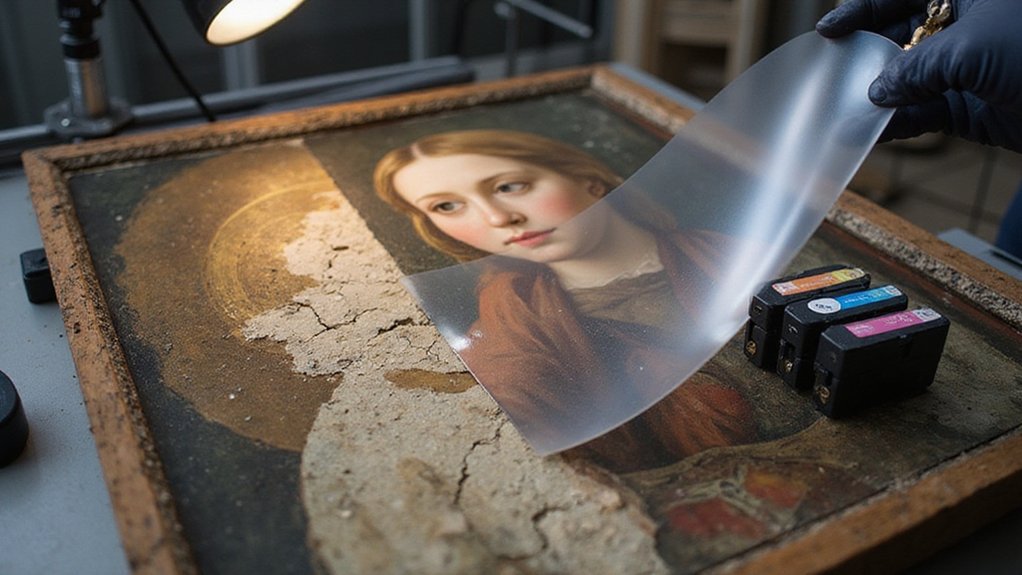
This transparent film acts as a physical mask that carries digital reconstructions of damaged art sections. It’s basically a high-tech Band-Aid for paintings. The two-layer design includes a precise color placement layer and a white underlay to guarantee vibrant, accurate color reproduction. And yes, it’s completely removable—conservators can dissolve the whole thing using standard chemicals without harming the original piece.
The real magic happens when AI enters the picture. Algorithms analyze damaged artwork, determining exactly what needs fixing and matching colors with uncanny precision. The computer handles complex patterns and textures that would make even the steadiest human hand tremble.
In one case, over 5,600 distinct regions with more than 57,000 different colors were restored in just 3.5 hours—a process 66 times faster than traditional techniques. That kind of efficiency is groundbreaking. Museums can finally address their restoration backlogs. Lesser-known paintings, previously deemed not worth the time investment, now have a fighting chance at restoration. More art coming out of storage? We’ll take it.
The technical precision is impressive. Using commercial inkjet printers, the film reproduces colors with sub-millimeter accuracy. This innovative approach has potential to restore up to 70% of damaged institutional paintings that currently languish in storage. No visible seams. No edges. Just art that looks whole again without a drop of new paint touching the original surface.
Conservation purists can relax. The entire process upholds core restoration principles: it’s reversible, meticulously documented, and minimally invasive. Digital records track every change, creating transparency for future conservators. The artwork’s historical authenticity remains intact. Innovative tech that actually respects tradition? Turns out it’s possible after all. This visionary method was developed by Alex Kachkine, an MIT mechanical engineering graduate student committed to making art more accessible to the public.
References
- https://news.mit.edu/2025/restoring-damaged-paintings-using-ai-generated-mask-0611
- https://newatlas.com/good-thinking/ai-classic-painting-restoration/
- https://www.smithsonianmag.com/smart-news/graduate-student-develops-an-ai-based-approach-to-restore-time-damaged-artwork-to-its-former-glory-180986799/
- https://cosmosmagazine.com/technology/computing/restoring-paintings-ai/
- https://www.edtechinnovationhub.com/news/mit-develops-ai-powered-mask-to-restore-damaged-paintings-in-hours-with-reversible-results