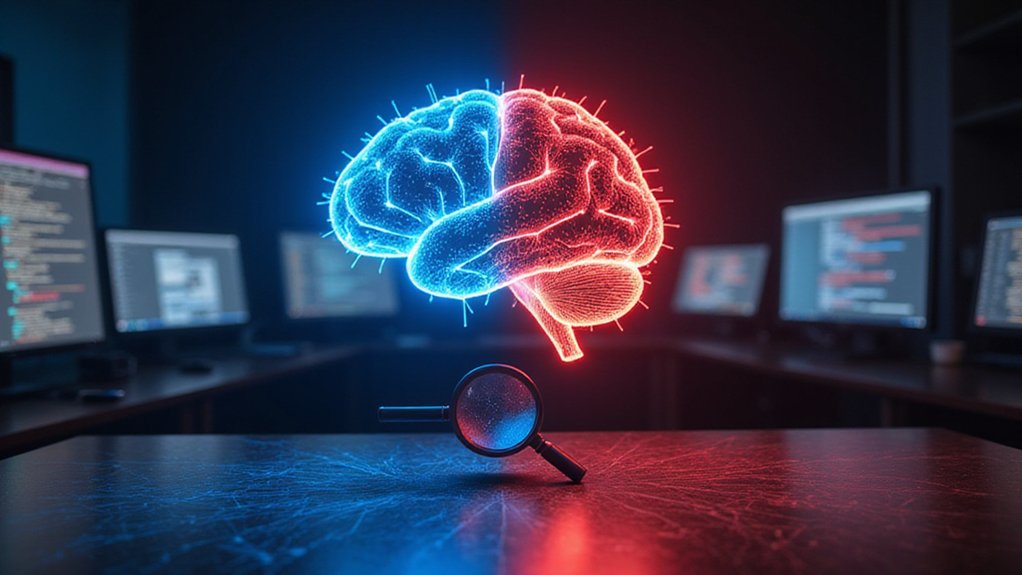
AI hallucinations occur when systems generate false information, affecting up to 27% of chatbot responses. These errors range from obvious falsehoods to subtle mistakes like fake citations. Poor training data and complex designs contribute to the problem. Experts are developing detection methods, including fact-checking procedures and automated validation tools. Comparing AI outputs against trusted sources helps identify errors. The growing integration of AI makes understanding these limitations increasingly important.
While artificial intelligence continues to advance at a rapid pace, researchers are increasingly concerned about a significant problem called AI hallucinations. These hallucinations occur when AI systems produce information that isn’t true or has no basis in reality. It’s like the AI is making things up when it doesn’t know the answer.
Studies show this isn’t a rare issue. Analysts found that chatbots hallucinate up to 27% of the time, with nearly half of AI-generated texts containing factual errors. This poses serious challenges for anyone relying on AI for accurate information.
AI hallucinations appear in up to 27% of chatbot responses, with factual errors plaguing nearly half of AI-generated content.
AI hallucinations come in different forms. Sometimes they’re obvious, like when an AI writes about events that never happened. Other times they’re subtle and harder to spot, which makes them potentially more dangerous. Both text and image-based AI systems can produce these false outputs.
Several factors contribute to hallucinations. Poor quality training data, complex model designs, and systems trying to make sense of unclear instructions all play a role. When AI is fed incomplete or inaccurate information, it’s more likely to produce made-up responses. The phenomenon is often compared to humans seeing faces in inanimate objects like clouds or the moon. Made-up academic citations and non-existent court cases are among the false outputs that damage institutional credibility.
Real-world examples highlight the problem. AI weather prediction systems have forecast rain with no meteorological basis. Image recognition tools have “seen” pandas in pictures of bicycles. The term “hallucination” was first used in this negative context by Google researchers in 2017 to describe neural translation errors. These errors show how AI can confidently present fiction as fact.
To address this issue, experts are developing detection methods and mitigation strategies. Fact-checking procedures, automated validation tools, and comparing outputs against trusted sources can help identify hallucinations. Improving training data quality and implementing content filters also reduces errors.
As AI becomes more integrated into our daily lives, addressing hallucinations is vital. Without proper safeguards, AI systems might spread misinformation or make critical mistakes in important areas like healthcare or finance. Research continues to focus on making these systems more reliable and trustworthy.