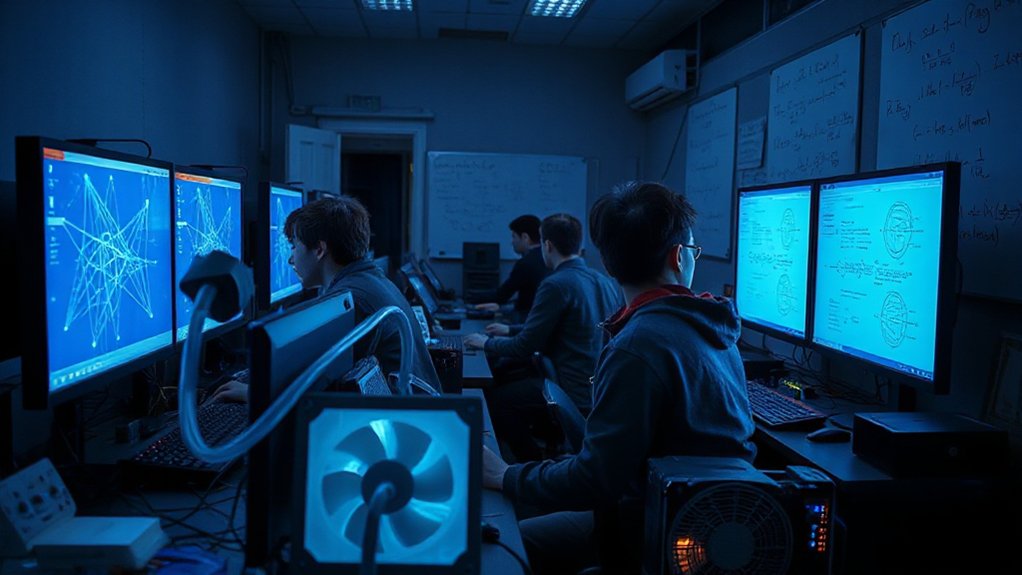

While the world watches China’s growing tech ambitions, its universities have quietly become the engine behind the country’s AI rise. Across the country, research institutes, labs, and interdisciplinary centers are driving model development and scientific breakthroughs. Tsinghua University stands out as a top AI research hub, producing strong numbers of papers and patents. Peking University, Shanghai Jiao Tong University, and Zhejiang University also contribute heavily to the nation’s AI output.
These schools now connect to national supercomputing networks, giving researchers access to powerful computing resources. This setup helps turn academic ideas into working AI systems faster than older lab models.
Government support has fueled this growth. Beijing funds basic AI research through the National Natural Science Foundation and national research programs. Cities like Shanghai and Shenzhen have built state-backed AI labs and pilot zones to speed up research and train talent. National planning has pushed “AI for Science” as a way to weave AI into everyday research. Beijing’s 3-year action plan also aims to establish a science-focused large language model and more than 10 scientific databases by 2027.
Higher-education policies now support university labs, research bases, and think tanks. Public funding has helped turn universities and state labs into globally competitive AI centers. China’s government has also directed significant investment into AI through national programs, with the global AI market projected to reach $190.61 billion by 2025 as countries compete for technological leadership.
The talent pipeline starts in classrooms. China’s Ministry of Education approved 35 universities to launch AI programs in 2018. By 2020, that number grew to 215. Experts estimate Chinese schools could produce 16,000 to 18,000 AI graduates each year by the end of the current five-year plan. This pipeline is reinforced by a striking reverse brain drain, with more than 85 U.S.-based scientists now joining Chinese institutions.
Universities have added new AI majors, colleges, and blended “AI+X” programs. Fudan University has become known for training scientists who join emerging research labs. Higher education is now a major source of China’s AI workforce.
Companies are joining in too. Alibaba has launched joint AI labs with Peking University and the University of Science and Technology of China. Its Damo Academy works with USTC on computing, cognitive intelligence, privacy tools, speech, and machine vision.
These partnerships help turn research into real-world products faster. Corporate involvement has strengthened university programs, even as access to advanced foreign chips grows harder. Together, these efforts show how deeply planned China’s AI progress has been.
References
- https://www.academicjobs.com/research-publication-news/ai-science-surge-chinese-universities-accelerate-layout-research-agents-transforming-scientific-paradigms-7970
- https://cen.acs.org/policy/china-research-labs-ai-artificial-intelligence-llm-agentic-supercomputer-microchip/104/web/2026/07
- https://news.cgtn.com/news/2026-07-19/VHJhbnNjcmlwdDkxNjI5/index.html
- https://www.scmp.com/tech/big-tech/article/3193012/alibaba-sets-ai-labs-two-prestigious-chinese-universities-washington
- https://events.techconnect.org/AISpring/abs2020.php?i=830
- https://www.rand.org/pubs/perspectives/PEA4012-1.html
- https://english.cas.cn/newsroom/archive/news_archive/nu2017/201705/t20170515_177076.shtml
- https://journals.sagepub.com/doi/10.1177/21582440241259012
- https://ai.tongji.edu.cn/yw.htm
- https://research.nus.edu.sg/eai/wp-content/uploads/2025/05/EAIBB-No.-1828-AI-Excellence_Chinas-Top-Universities-synopsis_exsum.pdf