
Every year, fashion brands dump millions of tons of perfectly good fabric into landfills. It’s wasteful. It’s expensive. And now, AI is doing something about it.
The numbers are staggering. About 30% of all clothing made never gets sold. Just sits there, collecting dust in warehouses before heading straight to the dump. But artificial intelligence is changing the game. These systems analyze sales history, market trends, even weather patterns to predict what people will actually buy. Brands can now adjust production on the fly, making fewer clothes that nobody wants.
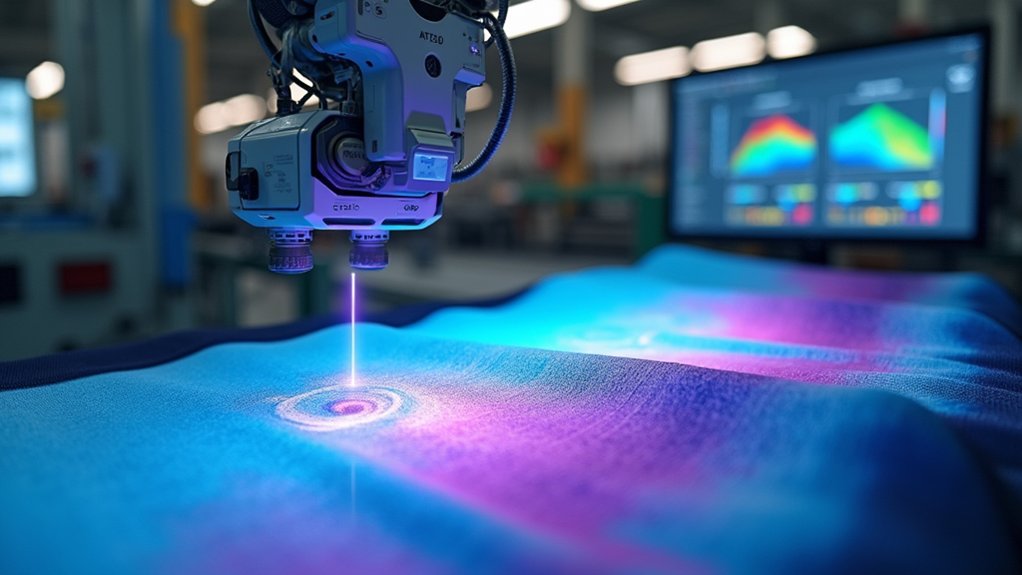
Computer vision is getting scary good at spotting defects too. AI-powered cameras scan fabrics during production, catching flaws that human eyes miss. One company, Smartex, claims their technology prevented a million kilograms of fabric from becoming waste. That’s a lot of perfectly good material saved from the trash heap.
AI cameras catch fabric flaws humans miss, saving millions of kilograms from landfills.
Then there’s the cutting room floor – literally. AI algorithms now arrange pattern pieces like the world’s most efficient jigsaw puzzle, squeezing every last bit of usable material from each bolt of fabric. Less waste, lower costs. Simple math that makes CFOs happy.
The recycling side is even more impressive. Current textile recycling rates? A pathetic 12%. But AI sorting systems can identify different fiber types and contaminants, potentially boosting that number to 70%. While these innovations promise environmental benefits, they contribute to the growing energy demands of data centers that power AI technologies. Considering polyester takes 200 years to decompose, this matters. Smart sorting technologies are becoming crucial as EU nations will require mandatory textile waste collection by 2025.
Real-time monitoring catches problems before they become disasters. AI platforms track production lines, spotting deviations that lead to waste and alerting operators instantly. No more discovering an entire batch is ruined after the fact. Machine learning models can now predict color changes during dyeing processes with remarkable accuracy, preventing costly color errors that force manufacturers to scrap entire fabric batches.
The market’s taking notice. Textile waste management is projected to balloon from $11.37 billion in 2025 to $23.31 billion by 2034. Companies are realizing that cutting waste isn’t just good PR – it’s good business.
Fashion’s waste problem won’t disappear overnight. But these AI tools are making a real dent, one algorithm at a time. Turns out, teaching machines to see patterns and predict trends might be exactly what this wasteful industry needs.
References
- https://news.ncsu.edu/2025/06/ai-can-help-cut-down-on-waste-improve-quality-in-dyed-fabrics/
- https://www.precedenceresearch.com/textile-waste-management-market
- https://prism.sustainability-directory.com/scenario/the-role-of-ai-in-textile-waste-reduction/
- https://www.rolandberger.com/publications/publication_pdf/Roland-Berger_From-waste-to-worth_Fashion.pdf
- https://stewarttownsend.com/ais-influence-on-the-fashion-industry-in-2025/