Stroke survivors struggling to form words are getting their voices back—thanks to AI. It’s about time. After years of painstaking speech therapy sessions and frustrating attempts at communication, artificial intelligence is changing the game for those with broken speech patterns. No more endless waiting for improvements. AI doesn’t have patience issues.
The tech works by analyzing millions of speech exercises—over 230 million from more than 100,000 patients, to be exact. That’s a lot of “ahhs” and “oohs.” This massive dataset helps create recovery prediction models that actually work. Dr. Kiran’s research emphasizes the importance of these recovery prediction models for personalizing rehabilitation approaches. Clinicians can now see what’s likely to happen next, not just hope for the best. Transformative stuff, really.
Speech analysis software detects the telltale signs of dysarthria and aphasia—fancy medical terms for “can’t talk right after a stroke.” The AI doesn’t compress recordings either. Every awkward pause and slurred syllable matters for accurate diagnosis. Try explaining that to your smartphone’s voice assistant.
AI captures every verbal stumble and hesitation—because in speech rehabilitation, imperfections are actually perfect diagnostic data.
The efficiency boost is significant. Therapists used to spend hours analyzing speech samples. Now? The computer does it in seconds. More time for actual therapy, less time pushing papers. What a concept. Patients get tailored feedback more often, not just whenever their overworked therapist can squeeze them in. The MARS Project is addressing this exact issue with its £470,000 funding to develop AI tools that automate time-consuming manual analysis currently burdening NHS speech therapists.
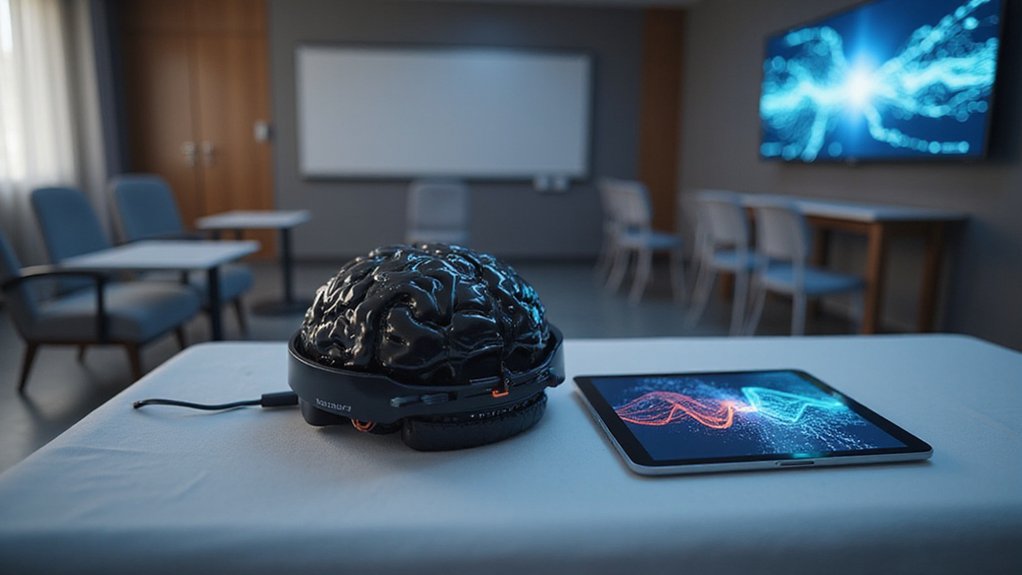
For those with severe paralysis, brain-computer interfaces with AI algorithms are decoding neural signals directly. Electrodes pick up brain activity, and AI translates it into words. It’s like mind-reading, but for good reasons. With AI applications in healthcare expected to reach market value of $208.2 billion by 2030, these speech rehabilitation technologies are positioned for explosive growth. Digital avatars even add facial expressions—because talking isn’t just about words.
The real win is in accessibility. Remote therapy options mean geography isn’t destiny anymore. Live in the middle of nowhere? AI doesn’t care. It’s leveling the playing field for all stroke survivors, not just the well-connected ones. From silence to speech, one algorithm at a time.
References
- https://nrtimes.co.uk/how-ai-is-supporting-speech-and-language-rehab-post-stroke/
- https://www.citystgeorges.ac.uk/news-and-events/news/2024/october/ai-transform-speech-therapy
- https://pmc.ncbi.nlm.nih.gov/articles/PMC10325939/
- https://www.ucsf.edu/news/2023/08/425986/how-artificial-intelligence-gave-paralyzed-woman-her-voice-back
- https://www.stroke.org.uk/research/artificial-intelligence-stroke-rehabilitation